Latest Post
Cabbage nutrition facts
Written By Unknown on Saturday, 29 December 2012 | 00:14
BY: A M Awan
 Rich in phyto-nutrients, this cool season leafy vegetable belongs to the "Brassica" family of vegetables, which also include brussels sprouts,cauliflower,bok choy, kale, and broccoli. It is one of the widely cultivated crops around the world.
Scientific name: Brassica oleracea (capitata group).
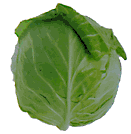
Cabbage structurally consists of clusters of stiff leaves superimposed one over the other in compact layers, giving it a round or globular shape. Several varieties are cultivated worldwide including green, purple, red, and savoy (loose-wrinkled leaves).
Bok-choyor "Chinese-cabbage" features similar appearance, but derived from different species of the same Brassica genus vegetables. Bok-choy characteristically has a vigorous growth pattern. The whole plant has a long cylindrical shape, comprising of short, compact leaves.

 Rich in phyto-nutrients, this cool season leafy vegetable belongs to the "Brassica" family of vegetables, which also include brussels sprouts,cauliflower,bok choy, kale, and broccoli. It is one of the widely cultivated crops around the world.
 Scientific name: Brassica oleracea (capitata group).
Cabbage structurally consists of clusters of stiff leaves superimposed one over the other in compact layers, giving it a round or globular shape. Several varieties are cultivated worldwide including green, purple, red, and savoy (loose-wrinkled leaves).
Bok-choyor "Chinese-cabbage" features similar appearance, but derived from different species of the same Brassica genus vegetables. Bok-choy characteristically has a vigorous growth pattern. The whole plant has a long cylindrical shape, comprising of short, compact leaves.
Health benefits of cabbage
- Fresh, dark green-leafy cabbage is incredibly nutritious; however, very low in fat and calories. 100 g of leaves provide just 25 calories.
- The vegetable is the storehouse of phyto-chemicals like thiocyanates, indole-3-carbinol, lutein, zea-xanthin, sulforaphane, and isothiocyanates. These compounds are powerful antioxidants and known to help protect against breast, colon, and prostate cancers and help reduce LDLor "bad cholesterol" levels in the blood.

Fresh cabbage is an excellent source of natural antioxidant, vitamin C. Provides 36.6 mg or about 61% of RDA, more than that of in the oranges. Regular consumption of foods rich in vitamin C helps the body develop resistance against infectious agents and scavenge harmful, pro-inflammatory free radicals.- Total antioxidant strength measured in terms of oxygen radical absorbance capacity (ORAC value) is 508 µmol TE/100 g. Red cabbages contain more antioxidant value, 2252 µmol TE/100 g.
- It is also rich in essential vitamins such as pantothenic acid (vitamin B-5), pyridoxine (vitamin B-6) and thiamin (vitamin B-1). These vitamins are essential in the sense that our body requires them from external sources to replenish.
- It also contains a adequate amount of minerals like potassium, manganese, iron, and magnesium. Potassium is an important component of cell and body fluids that helps controlling heart rate and blood pressure. Manganese is used by the body as a co-factor for the antioxidant enzyme, superoxide dismutase.Iron is required for the red blood cell formation.
- Cabbage is a very good source of vitamin K, provides about 63% of RDA levels. Vitamin-K has the potential role in bone metabolism by promoting osteotrophic activity in them. So enough vitamin K in the diet gives you healthy bones. In addition, vitamin-K also has established role in curing Alzheimer's disease patients by limiting neuronal damage in their brain.
The science of compost
Written By Unknown on Friday, 28 December 2012 | 09:45

Composting at home is fairly straightforward, but can go wrong quickly, and your nose knows when the compost container isn’t working properly. A functioning compost pile should smell faintly like warm earth. There are several causes of foul-smelling compost, and several practical solutions.
Mark King is a compost expert with the division of solid waste management at the Maine Department of Environmental Protection. He said all stinky compost problems come down to “breakdowns in pile management,” largely due to neglect.
“Many people read how easy it is to compost and tend to think you can just toss stuff into a pile and in six to 12 months you will have compost,” King said. “This popular misconception has led to more than a few unhappy home owners who end up with a stinky offensive mess. However, provided with the proper technical support and educational outreach, they are able to turn things around, and happiness returns.”
The magic of microbes
Though compost may seem like magic, it relies on little critters — either microbes or worms. As King explains, these helpers require food, air and water.
“Microbes rely upon a balance of carbon and nitrogen. Carbon provides the energy source, and nitrogen is used as ‘building blocks’ to produce more microbes,” King said. Specifically, this recipe translates to 30 or 40 parts paper or leaves (carbon) per one part food scraps or grass clippings (nitrogen). The mix must be kept moist and well-aerated.
If the mix is right, the microbes produce compost, carbon dioxide and water vapor. Without enough oxygen or the wrong mix, it could start producing stinky volatile organic acids.
Time and temperature: The keys to compost

King recommends taking the temperature of a compost pile. The goal is temperatures above 120 degrees Fahrenheit.
Richard Stehouwer is an associate professor of environmental soil science at Penn State University. He explains why cooler compost isn’t doing its job.
“Anaerobic decomposition is much slower and generates far less heat than aerobic decomposition,” he said. “So heat dissipates from the pile as quickly as it is being generated and the pile temperature does not increase. In these systems anything that prevents oxygen from reaching zones in the pile where decomposition is ongoing will result in anaerobic conditions and production of malodorous gasses.”
“Optimizing the recipe will create an odor-free, aerobic environment,” King said. “When any of these items are out of balance, odors ensue. The good news is that with proper attention, most problems are easily fixed and odors go away.”
Stehouwer offers the following troubleshooting suggestions for cold, stinky compost bins:
1. Mix the carbon and the food scraps more thoroughly, so the decomposing food can diffuse oxygen faster than it consumes oxygen.
2. Mix more dry leaves or paper into a pile that may be too wet. “The rate of oxygen diffusion through water is 10,000 times slower than through air,” he said.
3. “Add material that will help create porosity,” he said, such as wood chips, straw and dry leaves. Large air gaps in a compost pile improve air flow and help the microbes do their job.
4. Add more carbon. Excess nitrogen, or food scraps, can generate stinky ammonia.
Preventing compost odors in the kitchen
The other major source of compost-related odors is the food scrap pile in the kitchen awaiting the trip to the compost bin. To avoid odors in the kitchen, King recommends storing less than a week’s worth of food in an airtight container, then feeding it to the compost microbes along with the recommended 30 to 40 times as much paper, leaves or other carbon.
The same general rules apply to worm compost, which also can start to smell with the wrong proportions of food, carbon and water. King warns against letting food scraps get too rotten. “Even worms have their standards.”
Stehouwer warns that worm compost bins can get stinky if users add more food or larger particles than worms can handle. He recommends chopping food into smaller pieces, and always adding plenty of paper or cardboard whenever food is added. Some vermicomposters use a small old blender or food processor to grind up the worm food.
Give the worms, or the microbes in a hot compost bin, the right mix of food, air and water, and they will generate valuable, earthy-smelling compost for your garden.
Source: MNN
Published on: 03/21/2011
Robot learns to pick the sweetest strawberries in UK
 Richard Dudley imagines a world where strawberries grow in perfect rows and every day a robot army "tastes" their colors before harvesting the ripe ones. The research scientist at the United Kingdom’s National Physical Laboratory is building a robot that uses multiple wavelengths of electromagnetic radiation to identify the sweetest, ripest fruit — then plucks it from the vine.
Strawberries are a fickle, high-value crop, and harvesting them is costly. Lucky for Dudley, though, they can be grown in a variety of robot-picking-friendly ways. He isn’t first to the droid-worker game — organizations in Spain, Japan, and the United States have produced tractors with gripping arms — but all of them have the same disadvantage: They have trouble differentiating between the leaves and the fruit. Dudley’s ‘bot solves this problem by analyzing the plants with a combo of micro-, radio, terahertz, and far-infrared waves.
So far, microwaves work best for strawberries. The waves find the fruit and measure its water content — an indicator of ripeness — effectively taking a taste test. "With microwaves, leaves are actually quite transparent," Dudley says. He describes it as a safe "x-ray eye," since actual x-rays would irradiate the crop. He hopes to work with a company that builds robotic arms to make the tech a commercial reality for farmers within a year.
Source: Fresh plaza
Published on: 8/8/2012

Pomegranate nutrition facts
Written By Unknown on Thursday, 27 December 2012 | 10:21
Pomegranate is among the most popular, nutritionally rich fruit with unique flavor, taste, and heath promoting characteristics. Along with berries, and some tropical exotics such as mango, it too has novel qualities of functional foods often called as “super fruits.”
 Botanically, it is a small size fruit-bearing deciduous tree belonging within the Lythraceaefamily, of genus: Punica. The fruit is thought to originate in the Sub-Himalayan range of North India. Scientific name: Punica granatum.
The tree grows to about five and eight meters tall. It is cultivated at a commercial scale in vast regions across Indian sub-continent, Iran, Caucuses and Mediterranean regions for its fruits. Completely grown-up tree bears numerous spherical, bright red, purple, or orange-yellow colored fruits depending on the cultivar types. Each fruit measures about 6-10 cm in diameter and weighs about 200 gm. Its outer skin or rind is tough and features leathery texture.
Interior of the fruit is separated by white, thin, spongy, membranous, bitter tissue into compartments. Such sections, packed as sacs, filled with tiny edible sweet, juicy, pink pulp encasing around a single, angular, soft or hard (in over-mature fruits) seed.
Pomegranate is one of the most extensively cultivated fruits for food, juice, flavor, and color, making it a common ingredient in new functional foods often called “super fruits."
The tree grows to about five and eight meters tall. It is cultivated at a commercial scale in vast regions across Indian sub-continent, Iran, Caucuses and Mediterranean regions for its fruits. Completely grown-up tree bears numerous spherical, bright red, purple, or orange-yellow colored fruits depending on the cultivar types. Each fruit measures about 6-10 cm in diameter and weighs about 200 gm. Its outer skin or rind is tough and features leathery texture.
Interior of the fruit is separated by white, thin, spongy, membranous, bitter tissue into compartments. Such sections, packed as sacs, filled with tiny edible sweet, juicy, pink pulp encasing around a single, angular, soft or hard (in over-mature fruits) seed.
Pomegranate is one of the most extensively cultivated fruits for food, juice, flavor, and color, making it a common ingredient in new functional foods often called “super fruits."
Health benefits of Pomegranate
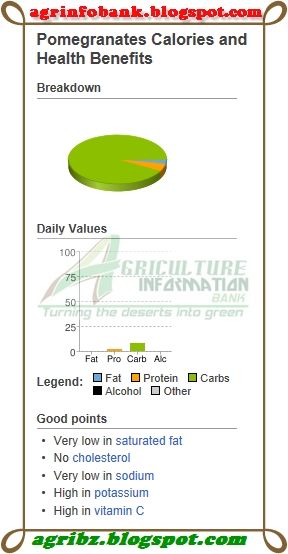
- The fruit is moderate in calories; 100 g provides 83 calories, slightly more than that in theapples. It contains no cholesterol or saturated fats.
- It is rich source of soluble and insoluble dietary fibers, providing about 4 g per 100 g (about 12% of RDA), which aid in smooth digestive and bowel movements. The fruit is suggested by nutritionists in the diet for weight reduction and cholesterol controlling programs. Regular inclusion of fruits in the diets boosts immunity, improves circulation, and offers protection from cancers.
- Punicalaginis a polyphenolic anti-oxidant compound found abundantly in the pomegranate juice. Studies suggest that punicalagin and tannins are effective in reducing heart-disease risk factors by scavenging harmful free radicals from the body.
- Total antioxidant strength of pomegranate fruit measured in terms of its oxygen radical absorbance capacity (ORAC) is 2341 µmol TE/100 g.
- The fruit is an also good source of antioxidant vitamin-C, provides about 17% per 100 g of daily requirement. Consumption of fruits rich in vitamin C helps the body develop resistance against infectious agents by boosting immunity.
- Regular consumption of pomegranate has also been found to be effective against prostate cancer, benign prostatic hyperplasia (BPH), diabetes, and lymphoma.
- Further, it is an also good source of many vital B-complex groups of vitamins such as pantothenic acid (vitamin B-5), folates, pyridoxine and vitamin K, and minerals like calcium, copper, potassium, and manganese.

Banana fruit nutrition facts

Scientific name: Musa acuminata colla.

In fact, the whole plant is a false stem (pseudostem), consisting of broad leaves along with their petioles overlapping around each other in a circular fashion standing up to 2 to 6 meters tall from the ground surface depending upon the cultivar types. At maturity, the rhizome gives rise to flower (inflorescence) that is carried up on a long smooth un-branched stem through the centre of the pseudo-stem emerging out at the top in the centre of the leaf cluster. The flower subsequently develops to hanging bunch consisting of 3 to 20 hands (tiers), each with at least 5-10 fingers (fruits) in each hand (tier). Banana plant or plantain bears hanging clusters of fruits as a bunch. Fruits are arranged in tiers, with 6-20 fruits in each tier.

Health benefits of banana fruit
- Banana fruit is one of the high calorie tropical fruits. 100 g of fruit provides 90 calories. Besides, it contains good amounts of health benefiting anti-oxidants, minerals, and vitamins.
- Banana pulp is composed of soft, easily digestible flesh with simple sugars like fructose and sucrose that when eaten replenishes energy and revitalizes the body instantly; thus, for these qualities, bananas are being used by athletes to get instant energy and as supplement food in the treatment plan for underweight children.
- The fruit contains a good amount of soluble dietary fiber (7% of DRA per 100 g) that helps normal bowel movements; thereby reducing constipation problems.
- It contains health promoting flavonoid poly-phenolic antioxidants such aslutein, zea-xanthin, ß and α-carotenes in small amounts. These compounds help act as protective scavengers against oxygen-derived free radicals and reactive oxygen species (ROS) that play a role in aging and various disease processes.
- It is also a very good source of vitamin-B6(pyridoxine), provides about 28% of daily-recommended allowance. Pyridoxine is an important B-complex vitamin that has a beneficial role for the treatment of neuritis, and anemia. Further, it helps decrease homocystine (one of the causative factors in coronary artery disease (CHD) and stroke episodes) levels within the body.
- The fruit is an also moderate source of vitamin-C (about 8.7 mg per 100g). Consumption of foods rich in vitamin-C helps the body develop resistance against infectious agents and scavenge harmful oxygen-free radicals.
- Fresh bananas provide adequate levels of minerals like copper, magnesium, and manganese. Magnesium is essential for bone strengthening and has a cardiac-protective role as well. Manganese is used by the body as a co-factor for the antioxidant enzyme, superoxide dismutase. Copper is required in the production of red blood cells.
- Fresh banana is a very rich source of potassium. 100 g fruit provides 358 mg potassium. Potassium is an important component of cell and body fluids that helps control heart rate and blood pressure, countering bad effects of sodium.


