Latest Post
Showing posts with label Home gardening. Show all posts

Environmental benefits of Turf grasses/ Well-maintained Lawns

Written By Unknown on Tuesday, 1 January 2013 | 06:56

Healthy well maintained lawns provide truly marvelous environmental benefits which contribute a lot to the world around it. Environmental benefits of Turf grasses/well-maintained lawns are as follows.
Cooler and quieter: when the heat is on, Turf grass helps keep you cool. Street or sidewalk temperatures may reach 100oF or higher, but turf remains at 75o. This could mean that the front lawns on a block of eight houses perform the same cooling work as 70 tons of air-conditioning-enough to cool off homes.
Turf also makes your life a bit quieter. It effectively absorbs and deflects sound. When combined with trees and other landscaping, a lawn can reduce harsh, unwanted noise to a distant murmur.
Help in breathing: A healthy lawn us an amazingly efficient production system. Turf plants remove carbon dioxide from the air and produce oxygen in return. Just 625 square feet of turfgrass supplies all the oxygen a person needs for one day. An average home lawn of 5,000 square feet produces enough oxygen for eight people each day. In comparison, it takes two 100-foot trees to provide the same amount of oxygen for eight people.
Soil saver: Turf grass controls erosion by knitting the soil together, trapping runoff water, and eliminating many of the problems caused by dust and mud. And it’s one of the more efficient water savers you will find in nature. A healthy lawn absorbs rainfall six time more effectively than does a wheat field.
Dust trap: if you have ever walked through a dry, barren area, such as a construction site, on a windy day, you have some idea of what life might be like without healthy lawns. Clouds of windblown dust make for difficult breathing, irritated eyes, and reduced visibility. Turfgrass is an effective air cleanser. It shows the air moving across its surface, so that dust particles settle out onto the blades and are eventually washed back to the ground. Every year Turfgrass traps millions of tons of dust that would otherwise blow unrestricted.
Pollution fighter: In one year’s time, the blades and roots in an acre of healthy turfgrass absorb hundreds of pounds of pollutants from the air and rainwater. Among them are sulpher dioxide, nitrogen oxide, hydrogen fluoride, nitrates, and other gases blamed for acid rain and greenhouse effect.
A common misconception is that the products put on lawns contribute to groundwater contamination and to algae blooms in nearby ponds and lakes. The truth is that few materials get past grass roots. The dense root system under a healthy lawn captures pollutants as water filters through the soil.
Safe surface: Perhaps the most important benefit is the recreational value lawns provide for young and old. Dense turf is a safer playground and playing field than nearly any other surface. It reduces the severity of many injuries and helps to cushion falls.

Six Air Purifying House Plants

Written By Unknown on Saturday, 29 December 2012 | 09:01

1. Bamboo Palm: According to NASA, it removes formaldahyde and is also said to act as a natural humidifier.

2. Snake Plant: Found by NASA to absorb nitrogen oxides and formaldahyde.

3. Areca Palm: One of the best air purifying plants for general air cleanliness.

4. Spider Plant: Great indoor plant for removing carbon monoxide and other toxins or impurities. Spider plants are one of three plants NASA deems best at removing formaldahyde from the air.

5. Peace Lily: Peace lilies could be called the “clean-all.” They’re often placed in bathrooms or laundry rooms because they’re known for removing mold spores. Also know to remove formaldahyde and trichloroethylene.

6. Gerbera Daisy: Not only do these gorgeous flowers remove benzene from the air, they’re known to improve sleep by absorbing carbon dioxide and giving off more oxygen over night.

If you can't even put a plant in your living room because you say it is too much trouble, then you need to die and wait for the other life to bring sense in your spirits!!!

Just do it. Random people like our whole team here are trying to put you back on your feet.. we arent doing that because we've got nothing else to do. We have families, too. We have ALL OF YOUR EXCUSES but yet, we're here, with you.

Garden Talk: A New Leaf in Your Home Garden

Written By Unknown on Thursday, 27 December 2012 | 02:21

By Zahrah Nasir
Q: I recently relocated to Islamabad from Karachi and wish to grow vegetables in my garden. Is this the right time? If so, please recommend three or four easy to grow ones and how to go about their cultivation.
A: Yes this is the perfect time to put in some vegetable seeds. At this time of the year it is best to grow your vegetables in a sunny position. You could start out with peas, carrots, spinach and lettuce which are all reasonably simple to grow. Peas, spinach and lettuce all do well in soil that has had lots of old, well-rotted, organic manure worked into it, whilst lettuce requires the same but with some river sand added to ensure good drainage.

Picture Source: Google
Peas should be sown half an inch deep and an inch apart to obtain strong plants and they will need supports, such as trellis-work or canes to climb up. Spinach and lettuce seeds should be sown, very thinly, about quarter of an inch deep, in rows four to five inches apart and lettuce seeds, these are very fine, thinly just under the soil surface, in rows six to 10 inches apart. Carrot seed, once again the seed is very small, is best sown thinly, just under the soil surface, in rows no more than six inches apart. All should be kept weed-free and watered regularly.
Q: I would appreciate your comments on my quick organic fertiliser recipe: One cup mustard/cotton oil cake powder. Half cup dry alfa powder. Half cup wood and paper ash. Half cup wood powder. Four or five powdered egg shells. Three to four rusty iron nails. Use 50/50 with soil.
A: Firstly I do not personally recommend the use of either mustard or cotton oil seed cake in the garden. Much better to use ‘bagass’ which is residual organic material from sugar mills. I am puzzled by ‘alfa powder’ unless you mean dried, ground up alfalfa which is fine. The wood/paper ash is good, as are the powdered egg shells; iron nails are good too if they are small ones and if you take care to bury them deeply in order to avoid accidents.
By ‘wood powder’, I presume that you mean sawdust. Fresh sawdust heats up as it rots down and will burn your plants and their tender roots. It should first be composted down and, only then used in the garden. It would be interesting to know how your plants have reacted to your fertiliser as detailed. Experimentation is great, please keep it up and growing organic is the best way to proceed.
Q: I have been nurturing an ivy creeper which finally developed roots and climbed the criss-cross wooden frame alongside my bay window. Over a period of five years the plant covered the whole structure and looked beautiful. Unfortunately, all of a sudden the leaves started yellowing and falling, leaving a large area bare. I thought that the tube well water — laboratory analysis says it is unfit for human consumption — could be the cause so I switched to normal sweet water praying that would help. The plant does appear to be developing new leaf buds but I am really worried about what to do.
A: Your ivy sounds gorgeous and you are commended for getting it to do so well. It is good that you stopped giving your ivy the tube well water as it sounds as if this was the problem.
The fact that, after switching over to sweet water, the ivy shows signs of growth is very encouraging and I think that patience should be exercised now. The plant should re-grow in time.
Q: I have a problem with my fig tree in Islamabad. The leaves are yellowing and falling. What should I do?
A: This tends to happen during periods of high summer humidity or rain and is absolutely nothing to worry about at all.
Q: I am trying to grow bananas and pomegranates but neither bear fruit. The leaves of both get so badly damaged by strong winds that they die. I recently added organic fertiliser to the soil and I water regularly. How can I improve their condition please?
A: Cultivating bananas and pomegranates in a windswept location is asking for trouble. The only solution to the problem is to erect wind protection, the type depending on the size of your garden.
Q: Is avocado a remedy for arthritis? Is it possible to purchase the plants in Karachi or do I need to look elsewhere?
A: Eating avocadoes will not cure arthritis but a poultice made from the bark and leaves is, it has been claimed, helpful in the treatment of rheumatism. I do not know if avocado saplings are now stocked in Karachi nurseries but I doubt it. Avocadoes grow into huge trees and both male and female are required for them to fruit. The climate of Karachi is not really suitable for their cultivation.
Source: The Dawn, InpaperMagzine
Published on: 10/15/2012

How To Grow Ginger At Home

Written By Unknown on Wednesday, 26 December 2012 | 09:34

When I started growing ginger root I expected it to be difficult. It's not.
Growing GingerI've been growing ginger at home for years, and ginger would have to be a serious contender for the title "most neglected plant" in my garden.
(Which is a shame. Ginger is a beautiful and beautifully scented plant. I really should move it. One day...)
I look at my ginger plants exactly once a year, at harvest time. I harvest them, replant them, and then forget about them for another year.

I easily grow a year's supply of ginger root from them. I also have plenty left over to give away, both ginger root planting material and ginger for eating.
You can get started using store bought ginger root. And you can easily grow ginger in pots or tubs, so growing ginger indoors is a possibility in cooler climates.
On this page I tell you everything you need to know about growing ginger, so you can grow your own fresh ginger, too.

Growing Ginger Root Is Not That Hard...

...provided you get a few basics right. Let's first look at some pictures of ginger plants and the roots:
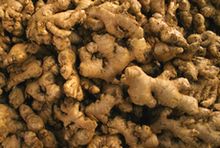
Foliage of ginger plants.A ginger rhizome with roots.
The picture on the left shows the foliage of ginger plants. On the right you see a rhizome.
To talk about ginger root when talking about the edible part of the ginger plant is actually incorrect. You eat the rhizomes, and as you can see, rhizomes have roots... Two different things...
But I'll keep talking about ginger root anyway, that's what everybody does and you know what I mean.

What ginger plants like and dislike:

Ginger loves a sheltered spot, filtered sunlight, warm weather, humidity, and rich, moist soil. (What else did you expect from a tropical plant?)
What ginger can't stand is frost, direct sun, strong winds, and soggy, waterlogged soil.

Planting Ginger Root

The easiest way to get started growing ginger root is to get a few fresh rhizomes of someone who does grow ginger, at the time when the plant re-shoots anyway (early spring). Otherwise just buy some at the shops at that time.
Ginger root with growth buds.
Make sure you select fresh, plump rhizomes.
Look for pieces with well developed "eyes" or growth buds. (The buds look like little horns at the end of a piece or "finger")
Some people recommend to soak the rhizomes in water over night. That's not a bad idea, since shop bought ginger might have been treated with a growth retardant.
I also read the advice to sit rhizomes in water until they sprout roots. That's nonsense. Your ginger plant will be much happier if the roots are in the ground and can breathe right from the start, rather than having to deal with the transplanting shock and the change in conditions. If the ground is moist and warm they will root very easily.
Whether you grow your ginger root in a pot or in the ground, you do need really good soil to start with. It needs to be rich enough to feed your ginger (you can always add some fertiliser, see below), it needs to hold enough moisture so it doesn't dry out, but it needs to be free draining so the ginger roots don't become water logged.
Good compost is of course ideal. I use a mix of one part of my best compost with one part of my sandy garden soil. The compost supplies the nutrition and holds water, and the sand/loam makes sure the mix drains freely.
If your garden has reasonable soil just dig in some compost and that should be good enough. If your soil is too heavy you can make a raised bed or a small hill or ridge to improve drainage.
The best planting time is late winter/early spring (late dry season/early wet season, in the true tropics). Make sure you select a spot where the plants get plenty of light but no direct sun, and where they are protected from wind.
You can cut or break up the ginger rhizomes in little pieces with a couple of growing buds each. Or just plant the whole thing. Plant your ginger root five to ten centimetres deep, with the growing buds facing up.

How much space?

Growing ginger doesn't take up much room at all. Every rhizome you plant will first only grow a few leaves, in the one spot. Over time it will become a dense clump and very slowly get bigger, but only if it isn't harvested.
The rhizomes underground also don't seem to mind if they become a bit crowded.
Ginger only grows to about two to three feet in height.
A 14 inch pot easily holds three average rhizomes, a rectangular styrofoam box holds about nine to a dozen. If planting them in the ground plant them about six to eight inches apart. And if you want to plant a whole hectare order 1000 - 1500 kg :-).

How much water?

Ginger needs a lot of moisture while actively growing. The soil should never dry out. Don't overwater, though, because the water that drains away will take nutrients with it.
Ginger loves humidity. If you have problems with dry air then regular spraying and misting might help. Dry air can cause problems with spider mites. But that's rather a problem for people who try to grow ginger out of its range and indoors. A sheltered, moist spot in a warm climate will provide enough humidity.
Mulched, young ginger plant
If you are growing ginger in the ground mulch it thickly.
It helps to keep the ground moist, it helps feed the ginger as the mulch breaks down, and it also keeps down weeds.
(Ginger is a slow growing plant and easily overgrown by others.)
Towards the end of summer, as the weather starts cooling down, your ginger will start to die back. Reduce the water, even let the ground dry out. This encourages the ginger to form rhizomes. Once all the leaves have died down your ginger is ready for harvest.

How much and which plant food?

If you are growing ginger in good, rich soil it shouldn't need anything extra. I grow mine in tubs. I put in fresh compost mix every year and never add any extra fertiliser.
If you don't have good soil, or if you are growing ginger in some standard bought potting mix, then you have to feed it regularly. You will also have to feed it if you are growing ginger in an area that gets torrential summer rains (many tropical regions do). Such rains leach all the goodness from the soil.
Work in some organic slow release fertiliser at planting time. After that you can use some liquid fertiliser like seaweed extract or fish fertiliser every few weeks.

When to harvest ginger root?

If you are growing ginger root in the garden you can start stealing little bits of it once it is about four months old. Just dig carefully at the side of a clump. (This "green ginger" does have a lot less flavour than the mature stuff, though.)
The best time to harvest ginger is any time after the leaves have died down. Usually it takes eight to ten months to get to that point.
Ginger growing in styrofoam boxes
You can now dig up the whole plant. The reason that I grow my ginger in tubs is that it makes the harvest so easy. I don't have to dig, I just tip out the whole thing.
Break up the rhizomes, select a few nice ones with good growing buds for replanting (you can replant them straight away), and keep the rest for the kitchen. (I simply peel, chop and freeze the whole lot. An even better way is to cut it into small chunks and store it in brandy. Brandied ginger keeps like fresh. Thank you to reader Jan Stevenson for this tip.)
The rhizomes that have been replanted or left in the ground don't need any water or attention until the weather warms up again. Mine still get watered where they are, and that doesn't seem to hurt them either.
The other way to grow and harvest ginger is to have many clumps growing around your place, and to just dig up what you need, when you need it. The plants grow outwards from the mature rhizomes. Once a clump is big enough you can harvest the mature tubers without damaging new shoots.
By the way, if you are serious about growing ginger at home then resist the urge to harvest it for a year or two. Rather build up a good resource stock first. I started with one little rhizome and dug it up the first time after two years. I replanted every single promising looking bud and still had some to eat. Next year I did the same, and after that I harvested enough to last me a year.

When does ginger flower?

When growing ginger as outlined above you won't see any flowers. A clump needs to be about two years old to flower. So if you want to see your ginger flower leave it in the ground, and just dig very carefully at the edges of it to harvest bits here and there.
The flowers of culinary ginger are green and insignificant anyway.
Ginger FlowerFlowering ginger plants.
There are however some spectacular flowering gingers. If you are after great flowers get some of those. They are grown exactly like the culinary ginger, just skip the harvest :-).
There's also a pretty variegated ginger, with white and green striped leaves. All the ornamental varieties are evergreen in the tropics (meaning they don't die down like the culinary ginger).

A few final notes for people in cool climates:

Don't expect to be harvesting much of your ginger plants. You'll be growing ginger mostly as an ornamental plant. It is a really pretty plant with its glossy strap leaves, and it smells beautifully when you brush against it.
Start your ginger indoors, it will be too cold outside in spring. Don't worry about the dappled sunlight. In your parts of the world the sun isn't as intense. Your ginger should be able to handle it and it needs all the warmth it can get.
You may or may not be able to keep it alive over winter, depending on where you are. Definitely move it inside at the first signs of cold weather. Once the leaves die back keep it reasonably dry and cool or the tubers will rot, and with a bit of luck your ginger may grow back next year.

Gardening for busy people

By Bunny Guinness, Telegraph
While some may be getting ready for the Olympics, I am checking over my bamboo canes, sharpening my saw and sorting my hurdles. Success on the sports field takes hard work, and it’s the same in the garden. For those with full-time jobs, children and other commitments, a bit more skill is needed to get results. With a little help from experts such as Charles Dowding and Kim Wilde, here is my guide to spring gardening for busy people:
Gardening for busy people
THE VEGETABLE PLOT
Raised beds
Charles Dowding is a professional vegetable grower. Like me, he uses the “No Dig” technique and finds it saves time and gives great yields. I never dig my veg (and rarely/ever ornamental borders) but just pile organic matter on (spent mushroom, garden compost) and the soil structure is brilliant.
If you have just a couple of raised beds and have extra space, then make another two (about 2.2m x 1.2m/7ft x 4ft) perhaps from old scaffold boards, and form a mini potager. Site them close to the house, so that you can have a quick potter, post-breakfast, to slay a stray weed and eye up what is ready for supper at the same time. Even if you’re suited and shod for the office, raised beds will allow you to reach everything without getting mulched yourself. Charles’s new book Vegetable Course (Frances Lincoln) is a must for the time-stretched.
Sowing and picking:
Charles recommends pick-and-come-again instead of cut-and-come for salads. Careful, weekly picking of salad plants’ outer leaves enables them to live longer, so you need to sow less often. “I have been practising it for nine years on all kinds of salad, including pea shoots and lettuce varieties such as Little Gem,” says Charles. “The same plants give leaves for 10 or 12 weeks, saving much time on sowing and clearing. For lettuce just two sowings – now and one in June – can give you leaves all the time from May to early autumn.”
Some plants require less attention than others, such as courgettes (try Defender), beetroot and chard (Fantasy F1, which is more spinach-like). But you rarely have something for nothing, and these plants need regular picking over to keep them in top condition. Other vegetables can be picked in a way that prolongs their productive life, to reduce time spent on sowing and raising new plants. Outer leaves twisted off spinach keeps it producing for longer than plants cut across the top. Beetroot grown in clumps, with just the larger ones twisted out when ready, allows the remaining roots to swell up. The same goes for carrots.
Have pots of herbs like thyme, lovage, chervil, parsley, lemon verbena and sage near the kitchen door so you can cut quicker than you can find the pack of the dried version.
BORDERS
Getting cottage garden borders to perform well in dry conditions takes a bit of juggling.
Firstly tackle the weeds, don’t plant anything new until you have outed perennial weeds. For this I would use glyphosate. No weeds must be allowed to seed (or even flower), so regular hoeing and/or the application of a thick mulch will sort this out. No digging allowed.
Get to know your weeds so you recognise them when small. Mulching (50mm/2in of coarse mulch) applied after watering is key. Use newspapers covered with copious grass cuttings to mulch wilder areas such as under new hedges.
Kim Wilde has an exceptionally busy and high-profile singing career, yet is an avid gardener. Here are her top tips for having great borders with less time:
“Without doubt, one of the most time-consuming activities in the garden is weeding. If planting an area for the first time, consider the use of landscape fabric (MyPex). Plants have a chance to establish and grow without weeds getting too much of a look in. Choose low maintenance, fast-growing herbaceous plants like ground-cover geraniums or Alchemilla mollis in areas where bulbs like tulips or alliums are to grow in the border, and landscape fabric is not an option. I grow G. macrorrhizum, and G x magnificum. These plants can be divided every few years, spread around the garden or given as Easter gifts.” Kim adds: “Before embarking on a love affair with your chosen plant, spend a few minutes researching its optimum growing conditions, i.e. likes a warm sunny sight, or prefers a damp shady spot. Giving your plant its ideal growing conditions will save you time and money in the long term.”
If you are short of time, having many different types of plants in your borders takes a lot more management than a few really generous clumps of the same plants. These bigger clumps need a good season of interest to work.
Helen Dillon, the gardening author and broadcaster, has a huge knowledge of plants and her garden in Dublin (dillongarden.com) is inspirational. Helen raves about cottage garden flowers, such as the mauve honesty, which produces beautiful, luminous flowers in spring, and then sets seed for next year. If you tend them and deadhead they perform for far longer (May-July is not unusual).
The unusual perennial honesty, Lunaria rediviva, is a “Helen gem”. This has white flowers and large, pointy oval leaves. It gets to a metre (3ft) tall and has wonderful evening scent from its white flowers. The only place I have seen it for sale is at Jelitto Seeds (jelitto.com), which specialises in wholesale perennial seeds. A plant Helen rates for later interest is Briza maxima (giant quaking grass). Sow it now and it will flower in August and last to December with its airy 3ft stems. Sow it again in August and it will flower next May.
Sweet rocket (Hesperis matronalis) and the perennial stock, Matthiola incana, with its useful, ever-grey leaves and scented flowers, are also her cottage garden musts.
LAWNS
The lawn is high input. A designed lawn, rather than just being the leftover space after you snatched bits for borders, paving and paths, makes a massive difference. A hard-working, green mown surface is a more realistic title than “lawn”. Leaving the wilder parts slightly longer and cutting and collecting at as long intervals as the machine will manage (maybe three weeks), but mowing paths through, gives a more romantic look. Mulch mowers (such as the John Deere JS63V) remove the need to collect, and help with drought. Longer meadows, left until early July for their first cut, look stunning in late spring but can get tatty later. But if these areas are limited to defined swathes, it makes them visually far more acceptable later on.
Tips:
- Do not feed grass if you have little tending time
- Cut a bit longer to encourage thymes, self-heal and other herbs so the area will stay greener in drought
- Spot-treat coarser weeds you do not like, such as dandelions, with selective lawn weed killer (I spot treat broadleaved weeds such as dandelions and dock with Verdone)
- Remove fiddly bits and replace with gravel, ground cover or easy planting
- Do not skimp on a mower but invest in one that is a joy to use (I love my Hayter)
Source: Telegraph
Published on: 04/01/2012

Fruit and vegetables treated with pesticides can cause Parkinson's disease

Fruit and vegetables treated with pesticides can cause Parkinsons, say scientists from the German University Clinic Carl Gustav Carus. The researchers came to this conclusion after extensive testing with mice.
In Germany alone 400,000 people are suffering from Parkinsons disease. Scientists have now discovered that the insecticide rotenone doesn’t just cause the disease, but exacerbates the symptoms. Earlier, researchers confirmed the fact that Parkinsons can be triggered by outside influences. Already in an early stage, distinct correlations were found between Parkinsons and the use of pesticides. Scientific research involving subjects active in agriculture and farming, used to working with pesticides, showed that an above average percentage of the subjects suffered from the disease.
Staff at the University examined the responses of mice to rotenone. It was established that certain nerve cells in the intestines contained large doses of the protein alpha-synuclein. These in turn affected important brain cells. According to Francisco Pan-Montojo of the Dresden Institute for Anatomy the discovery is an important step forward in the understanding and possible treatment of Parkinsons.

Source: Fresh Plaza
Published on: 12/14/2012

Garden Talk: The Sage Advice

By Zahra Nasir
Indigenous in all countries surrounding the Mediterranean, sage has been cultivated throughout Europe for hundreds of years. Zahra Nasir teaches gardening-buffs how to grow the herb in Pakistani soil
Well, ladies, make no bones about it, if you want to stand up and make a statement about who really rules the roost; simply plant sage in your garden. If your sage flourishes then this is an indelible sign to all and sundry that matriarchy prevails in your home. But on the other hand, if your sage withers and dies then quickly pull it out, hide it away, dispose it off quietly, for if someone finds out then everyone will know you have submitted to male domination albeit Taliban style or otherwise. Sage you see, is and has from ancient times, been considered a very female herb.
Garden Talk: The Sage Advice
There are actually around 900 different kinds of sage, botanically known as ‘Salvias’. Sage is a member of the ‘Lamiaceae’ family of plants but the one we are talking about here is that good old medicinal and culinary herb ‘Salvia officinalis’ or ‘Common’ sage although there really isn’t anything at all common about its myriad properties.
Members of this huge genus are, except for a 100 or so, aromatic and can be annuals, biennials or perennials and can be evergreen or deciduous with, mostly, strong woody stems. The sage in question, with attractive velvety, silvery green, dare I say ‘sage green’ leaves which it may or, being awkward, may not hang on to all year round is a hardy perennial. Although its bare woody stems are not at all ornamental, its other properties more than make up for this with its spectacular spires of blue flowers in the spring proffering a splendid apology for anything it may have done to offend you.
Indigenous in all the countries surrounding the Mediterranean, including North Africa, sage has been widely cultivated throughout Europe for literally hundreds of years. It was introduced to North America sometime in the 1600s and was so venerated by the Chinese during the same period of history (should that be ‘her-story’ in this instance?) that they happily bartered three chests of top quality tea for a single chest of dried sage with European traders.
As its origins belie, this particular sage adores sunny, well drained positions in reasonably light, sandy soil although it will tolerate, my own plants are an example, much heavier, humus rich soil as long as it never ever gets water logged as this means almost instant death. Whilst sage is, or rather was, considered to have the ability to bring people back to life if one is to believe ancient Druid and Roman lore, sadly it cannot resurrect itself and when it decides to give up the ghost… it does!
Hippocrates, the ancestor of modern doctors and their Hippocratic oath, Dioscorides and Marcus Aurelius’ doctor by the name of Galen all promoted the use of sage for a wide variety of female illnesses and problems and, much later on, Pliny the Elder venerated it as a top notch herb for treating wounds and snake bites and its botanical name ‘Salvia’ is actually derived from the Latin word ‘Salvere’ which means to be in the best of health. Closer to home in a manner of speaking, in the Arab world, sage is considered to be brain food and was once prescribed for boosting intelligence.
Growing to a height of approximately three feet if it is happy, much less if it isn’t quite comfortable, sage is an astringent, antiseptic herb with a very strong and pleasing aroma. It has been found to relax spasms, prevent sweating, improve digestion, help with liver function and has anti-inflammatory and anti-depressant uses. Modern herbalists prescribe it, taken internally, for indigestion, liver problems, flatulence, to ease lactation and for a whole range of female problems as identified by the ancient Romans. Externally it is used for nasty insect bites, sore throats and mouths plus various skin infections.
Then of course it has numerous culinary uses too. The pungent leaves can be used in all sorts of meat, fish and poultry dishes, a Christmas turkey stuffed with sage and onion being a prime example. The leaves, fresh or dried, make an excellent herb tea or can be used for adding a delicious flavour to homemade cheese and, having told you all of the above I’m certain you, ladies in particular, would like to cultivate a few plants for home use.
The first thing you need is seed of course and I have found good quality German seed in the market here which has (at least mine did) a germination rate of about 90 per cent. I paid Rs. 80 per packet last April and ended up with four dozen healthy plants which, in my opinion, was a very good deal.
The hard black seed, almost round in shape, should be sown in pots or trays of good, well draining compost. About quarter of an inch deep is ideal. Place the pots/trays in a sunny location; keep them watered but not overly wet and the seeds should begin to germinate after 10 to 14 days. Don’t plant the seeds too close together, three inches apart all round is ideal, to allow the seedlings room to grow without having to endure competition from their neighbours. Once they have developed four to six healthy leaves, carefully transplant them into individual 10-inch pots or plant them out, one to two feet apart, directly in the garden. Those of you without an actual garden can keep them in pots which, in adverse weather conditions such as heavy rain, can be kept in a sheltered place.
As previously mentioned, this particular kind of sage is a perennial plant but, sadly, that doesn’t mean it lives forever. It should be pretty and productive for three to four years after which it will tend to get rather woody, have fewer leaves and not be so attractive therefore you should start a new batch off every couple of years or so. Once you have got an established sage plant it can easily be increased by taking cuttings during late spring or early autumn.
Now, the all-important climatic requirements. Sage the sun lover needs sunshine and dry growing conditions. If you happen to reside in Karachi then sow the seed during October or November and keep your fingers crossed that the plants produce lots of leaves before humidity creeps up during early summer as they may not like this at all. Keeping them on a sunny, covered veranda where dew/humidity don’t directly fall on them, will encourage them to survive the summer but it could be that you need to treat them as an annual plant. In Lahore, Rawalpindi and Islamabad, you can sow the seed either in September/October or during late February/March and, as humidity tends to be a little lower than in Karachi, the plants will have more chance of being perennial. In Quetta, Peshawar and cooler hilly regions seed should be sown during spring and, more than likely, the plants will be perfectly good perennials.

Indigenous species of wild sage are found almost all over Pakistan but, whilst perfectly useable, they are not quite as ‘strong’ as Salvia officinalis and neither are their flowers so eye-catching. A useful species, easily grown as an annual although it is really a biennial, is ‘Salvia sclarea’ or Clary sage, an equally useful herb with highly decorative purple, pink or white bracts, and whilst it is very different from ‘Salvia splendens’, the normal sock-you-in-the-eye garden variety which doesn’t have any of the medicinal or culinary merits mentioned above, it is a wonderful addition to anyone’s garden.
Sage, in any form, should not be taken internally for any length of time and not at all if you happen to be pregnant or suffer from epilepsy. Salvia officinalis has a high content of volatile oil of which up to 50 per cent is Thujone and in excess this is toxic. Do not concoct your own herbal remedies as this can be dangerous, please leave this to the experts.
Source: The Dawn Review
Published on: 10/23/2012

Garden Talk: Time To Grow Green and Purple

By Zahrah Nasir
Q: I am planning to cultivate quite a lot of basil and would be grateful if you can guide me through the basics. How to sow the seed, soil conditions, fertiliser, watering and where to get good quality seed.
A: Basil, there are many varieties with different coloured/shaped leaves and different flavours, is very simple to grow from seed. The seedlings do not like being disturbed as they have a long tap root which is easily damaged so it is best to sow them very thinly and according to species, as some are larger than others, where they are to grow.

Garden Talk: Time To Grow Green and Purple

Soil that is rich in organic material is ideal. Basil flourishes in full sun and while it requires regular watering, good drainage is essential. The seed needs warmth to germinate so is best sown in spring when temperatures are on the rise although it can also be started off in autumn before temperatures drop and then grown under plastic/glass for the winter.
Once you have some mature plants, these can also be increased by propagating from cuttings. Basil should not require additional fertiliser if the soil is correctly prepared prior to sowing the seed. Nip out the central growing shoots when the plants are four to six inches high, this encourages them to bush out and produce more of their deliciously aromatic leaves. Keeping the strongest plants for seed production is always, as long as the seed was not hybrid, a good idea. You need to shop around for seed and perhaps, especially if opting for an ‘unusual’ variety, import it yourself.
Q: Is there any species of perennial viola, a fragrant one, which can be grown in Lahore?

A: I am delighted to say that there is! Viola odorata is the answer. Grow it in partial shade, keep watered and you will be magnificently rewarded.
Q: For the past few years I am unable to make my Nerine bowdenii flower. I am growing it in medium-size plastic pots. It does grow leaves but does not go dormant at all. I think that it should go dormant before the monsoon and then flower in August/September. Any tips?

A: The plant needs to have a rest in order to build up enough energy to flower: Going on and on producing leaves uses all its strength up. I would suggest giving it a hand by withholding water for at least six weeks before the arrival of the monsoon and then let nature take over.
Q: I’m into growing flowers at my place outside Lahore. I want to grow something which is not a run-of-the-mill commodity. Any ideas?

A: If these are to be used as cut flowers then I suggest the following: Venidium, platycodon, rudbeckia, inula, ismelia, bracteantha and please don’t overlook dahlias as there are literally hundreds of beautiful varieties and they all, especially the long-stemmed ones, make excellent cut flowers.
Q: I am planning on growing some tall trees around my house in Quetta and am thinking of coconuts or some other type of palm. Kindly tell me if I can do this and, if so, then what it is the best time to plant them. If this is not possible then please suggest a suitable species.
A: Coconuts are not suitable for Quetta and, aside from date palms, I strongly suggest that you avoid any kind of palm at all as they are liable to suffer frost damage in the winter. I realise that you want something tall and graceful but it really makes more sense, given the prevailing economic conditions, to grow something productive like a selection of fruit trees to give you fresh produce over as long a period as possible.

Q: Can blue hibiscus be grown successfully in Lahore — I haven’t seen them here. There are two most common species with blue flowers Alyogyne huegelli and Hibiscus syriacus. Can these be grown in Lahore from seed and do they require the same care as wild hibiscus?
A: I suspect that you mean Hibiscus huegelli not Alyogyne. H. huegelli, the Australian satin hibiscus with gorgeous lavender coloured flowers and Hibiscus syriacus should both be fine as long as good growing conditions are provided. They are very different in their requirements to wild hibiscus. Give them well drained, sandy soil with lots of humus worked in and grow in full sun. Take care that the seedlings do not damp off.
Picture source: Google.

Source: The Dawn, InpaperMagzine
Published on: 10/25/2012

Garden Talk: Planting Ideas

By Zahrah Nasir
Q: I have an area of land close to Bahawalpur and want to develop it for personal agricultural use. Please give me some advice as to what I should grow there. I would ideally prefer a mix of edible and ornamental species of plants.
A: Depending on the area of land concerned I would suggest that you put part of it down to grain, part to vegetables and herbs and a smaller section to whatever ornamentals you desire although, frankly speaking, I would give the latter a miss. Dividing the area up with rows of fruit trees would help maximise land use and provide shade for seasonal crops during the blazing summer heat in your locality. As long as water isn’t an issue and soil salinity is minimal you have lots of choice.

Garden Talk: Planting Ideas

Q: You once suggested that garlic vine is very adaptable to the climates of Karachi and Lahore but I have tried with two plants, from different nurseries in Lahore, and they are not performing well. There are no signs of pests or disease but the plants do not put on new growth. I tried directly in the soil and in a pot. I changed the soil and added fertiliser but still the plants do not grow. Are you sure that garlic vine grows in Lahore and, if so, what could possibly be wrong?

A: Garlic vines grow wonderfully in Lahore! From what you say though I suspect that you are disturbing yours before they have a chance to spread out their root systems and take off. Moving plants around gives them a ‘check’ and they suffer badly from this as, each time they are disturbed, the root system suffers. Just leave them be, let nature take its course and if they survive the trauma they have already suffered, they will reward you in time.
Q: I am interested in growing ‘Abronia’ (sand verbena) in Lahore for its fragrant flowers. Should it be grown in sandy soil? Will it be perennial and is it suitable for here?

A: Abronia should do well in Lahore and will be perennial providing that correct growing conditions are maintained. This species needs almost pure sand with excellent drainage. Seedlings and young plants will need a little water from time to time but mature plants do not. The only potential problem is during the summer monsoon when, if at all possible, the plants should be protected from the rain and associated high humidity. You could perhaps erect some form of temporary shelter over them during this period.
Q: Are there any shrubs which flower before they come into leaf that are suitable for cultivation in Lahore? I know of two members of the ‘Prunus’ family that do this but they are not easy to grow here.
A: Yes. Forsythia, with its glorious golden flowers in very early spring, will meet your needs.
Q: I grew some gorgeous geraniums from seed this year and they are in full bloom. I have them in pots on a sunny veranda in Islamabad and they are in perfect health. What I need to know is: Do I have to bring them indoors for the winter or will they be okay where they are.

A: Geraniums are more cold tolerant than people tend to think. They should be absolutely fine in your veranda as long as it isn’t exposed to cold winds. If you are very concerned, and I can understand if you are, then take them indoors and place them where they get plenty of natural light and put them back outside in early spring.
Q: Can climbers from the ‘Asarina’ family, such as ‘Maurandia’ and ‘Asarina’ be grown in Lahore and, if so, in which month should the seeds be sown?
A: Asarina itself is fine but Maurandia may be a little more problematic. Both should be sown during early spring as soon as the temperature begins to rise but, even then, starting them off under glass or at least covering them at night is recommended.
Q: Which varieties of ‘Lillium’ are suitable for hot climates like Lahore? I am not happy with either Oriental or Asiatic lilies. I would also prefer a variety which can be kept in the soil all summer instead of having to be dug up and stored.

A: Oriental and Asiatic lilies are about the best bet in Lahore and neither of them should be dug up and stored at any point in the year. As long as drainage is good, the bulbs will rot otherwise, they should thrive and multiply if left in the ground. Putting them into storage is unnatural and breaks their natural growing cycle.
Q: I want to cultivate mushrooms in a pot in my house in Lahore. Where can I get spawn and other related material?
A: I suggest that you contact the Horticultural Department of Faisalabad Agricultural University for full growing instructions, advice and for spawn. You should find a contact via an internet search.
Picture source: Google.
Source: The Dawn, InpaperMagzine
Published on: 12/09/2012

Why Bamboo should not be planted in your home

Bamboo is a trendy star of the eco-friendly construction movement, with a wide variety of flooring, furniture and other items being manufactured with the strong, fast-growing grass. However, bamboo production should be left to commercial growers. Bamboo’s hardiness and rapid growth make it a problematic plant for most yards. Here are the top five reasons not to plant bamboo in your garden.
1. Bamboo can spread into neighboring yards.
Many homeowners plant bamboo to create a fast-growing privacy screen around their home. Ted Jordan Meredith, author of "Bamboo for Gardens," notes that some bamboo species can grow more than three feet per day. Bamboo can spread as quickly as it grows, and it doesn’t respect fences or property lines.

Why Bamboo should not be planted in your home


Bamboo grows particularly vigorously when adjacent to irrigated lawns and gardens or in low-lying areas that collect water. Instead of just blocking the view of nosy neighbors, you could be turning your property line into a war zone by planting bamboo.
Some bamboo species may even be categorized as noxious weeds, meaning a neighbor could legally force you to remove your bamboo. You could also be liable for the cost of any damage to the neighbors’ property caused by your bamboo, and for the cost of removal from their property.
2. Bamboo can be an invasive threat to biodiversity.
Bamboo that spreads and escapes your yard can also cause ecological problems. Many spreading bamboo species are categorized as invasive exotic plants that crowd out native plants and threaten biodiversity.
The best ways to contain spreading bamboo can be expensive and complicated, and may not be worth pursuing for many homeowners. Moreover, they are not foolproof. Experts at the University of Georgia Cooperative Extension office recommend burying thick 60-ml polypropylene or fiberglass about three feet deep, and leaving another two inches of material above the soil to inhibit surface spreading. Morgan Judy of Clemson University Cooperative Extension suggests creating a solid barrier made of concrete, metal or pressure-treated wood at least 18 inches deep around the bamboo.
Any of these barriers should stop shallow bamboo rhizomes from spreading, but Judy still recommends closely monitoring the area for escaping shoots, particularly during the early summer peak growing season.
3. Getting rid of bamboo can take years.
Bamboo is a long-term relationship that should not be entered lightly. It may take years and vigorous effort to remove unwanted bamboo. The first step in removing bamboo is to remove all the root mass and rhizomes. This is easier said than done, and many homeowners with bamboo-loving neighbors complain they can’t get rid of the spreading grass. No matter how much they dig, the shoots keep coming back.
Judy suggests frequent mowing can deplete and starve the bamboo, but it take at least two years of regular mowing to see any results.
4. Getting rid of bamboo may require herbicides.
Moreover, Judy notes that chemical herbicides are often necessary for controlling bamboo. This can be a problem for those trying to maintain organic gardens and avoid herbicide use.
She recommends Roundup Original, Quick Kill Grass and Weed Killer and other herbicides containing glyphosate. This broad-spectrum herbicide has minimal residual soil activity and typically only kills the plants that are directly sprayed. Mow or chop the bamboo and let it regrow until new leaves expand. Then spray the herbicide on the leaves.
Again, this could take years. One application will not solve your bamboo problem. Also, Judy warns that only specialized glyphosate herbicides should be used near creeks, ponds and other surface water. Eraser AQ, Pondmaster and other products are approved for use near water.
5. The right bamboo can be hard to find.
Bamboo’s defenders will argue that not all of the more than 1,000 bamboo species are equally invasive. They recommend clumping bamboo species rather than spreading types. The problem is that even clumping species spread, albeit not as vigorously. It also can be hard to differentiate between the types, and some are mislabeled. Moreover, other similar invasive species may be confused with bamboo. For example, University of Arizona Cooperative Extension officials warn against transplanting or encouraging the giant reed (Arundo donax), a bamboo look-alike that has invaded parts of their state.
Bamboo may seem like an attractive garden option, but it poses serious problems. Stick to a lucky bamboo in a small indoor pot, or avoid growing bamboo altogether. Moreover, do your homework before buying bamboo flooring and other products. It may not be as eco-friendly or durable as you think.
Source: MNN
Published on: 07/17/2011

A Vegetable Garden at home

Written By Unknown on Saturday, 15 December 2012 | 07:58


A Vegetable Garden at home
.
 
Support : Oasis Agro Pak | Agrinfobank | Power By:Blogger
Copyright © 2012-2013. E-AgriBusiness - All Rights Reserved
Template Modify by Malik Published by A M Awan
Proudly powered by Blogger