Latest Post
Showing posts with label Pakistan. Show all posts
Showing posts with label Pakistan. Show all posts
Pakistan hopes for Date export
Written By Unknown on Wednesday, 26 December 2012 | 08:57
The Director General of the Sindh Board of Investment has stated that Sindh dates have huge potential in international markets, should they receive some investment.
 A trade mission led by the Sindh Board of Investment, consisting of date palm growers visited the processing plant of Al-Foah Date Processing Company located in Al-Ain, UAE.
The plant was established by the Emirates government 14 years ago and is considered to be cutting edge.
Sindh produces more than 300,000 tons of dates per annum and the total date production of Pakistan crosses 600,000 tons. However, due to a lack of processing techniques and value addition to the sector, the country has never successfully courted the international marketplace for this product. Exports usually focus on pitted dates or low quality produce for processing - both of which offer low returns.
The board hopes that the visit it organised will suggest the potential for the industry and encourage growers and investors to do more.
Source: nation.com.pk
 A trade mission led by the Sindh Board of Investment, consisting of date palm growers visited the processing plant of Al-Foah Date Processing Company located in Al-Ain, UAE.
The plant was established by the Emirates government 14 years ago and is considered to be cutting edge.
Sindh produces more than 300,000 tons of dates per annum and the total date production of Pakistan crosses 600,000 tons. However, due to a lack of processing techniques and value addition to the sector, the country has never successfully courted the international marketplace for this product. Exports usually focus on pitted dates or low quality produce for processing - both of which offer low returns.
The board hopes that the visit it organised will suggest the potential for the industry and encourage growers and investors to do more.
Source: nation.com.pk
Pakistan has commenced Kinnow export on 1st December
 Pakistan has commenced kinnow export this year with the first consignment of 390 tonnes shipped to Sri Lanka and Dubai. The whole country started on the same day - December 1st, as the Ministry of Commerce prohibited earlier export.
According to Waheed Ahmed, Chairman, All Pakistan Fruit and Vegetable Exporters Importers and Merchant Association (PFVA) at least 15 containers each have been sent to Dubai and Sri Lanka.
This year's production is expected to reach 1.8 million tonnes, a reduction of 20%. if Pakistan reaches its export target this year (0.2 million tonnes), international sales should generate in the region of $110 million.
Pakistan has lost an important market as US sanctions have made it difficult to export to Iran. There are hopes that increased trade with Indonesia will offset the loss of Iran.
Source: brecorder.com
Published on: 12/4/2012
Textile ministry joins farmers in denouncing trade with India
Written By Unknown on Sunday, 23 December 2012 | 00:05

The Ministry of Textile Industry now says that the future of local industry seems bleak because of the “hasty” decision to open Pakistani markets for Indian textiles.
--------------------------------------------------------------------------------------------------------------------------ISLAMABAD: After Pakistani farmers’ recent lobbying to prevent imports of agricultural produce from India, the Ministry of Textile Industry, too, seems to be getting cold feet ahead of the liberalisation of trade between the two estranged neighbours. Its apprehensions over the import of Indian textiles have surfaced hardly a month before the government is expected to phase out its negative list for goods tradable with India.
The Ministry of Textile Industry now says that the future of local industry seems bleak because of the “hasty” decision to open Pakistani markets for Indian textiles. It claims that allowing imports at reduced rates under the Most Favoured Nation (MFN) regime will swallow up the domestic textile sector.
Echoing similar concerns first raised by farmers on imports of India’s agricultural produce, the ministry says that the Indian textile industry enjoys “huge” subsidies and tariff protection, which will lead to imbalances in the market and affect Pakistani farmers. It has argued that India and Bangladesh have realised the importance of the textile sector in their economic development, growth of exports and generation of employment and therefore protect their industry. The ministry says that Pakistan should also protect its textile sector, which it fears will be “destroyed” after the entrance of Indian goods into domestic markets.
“We have still not been able to export more than $272 million worth of goods to India, whereas India has exported around $1.5 billion worth of commodities to Pakistan, being allowed 1,900 tariff lines,” the textile ministry said in its comments on trade with India after the grant of the MFN status. It added that Pakistan exported only $45 million worth of textile products to India in 2010, whereas India exported $566 million worth of textile products to Pakistan while the negative list was still in force.
Under the South Asian Free Trade Area (Safta) agreement, tariff rates are to be held between 0%-5% on all products not on a country’s sensitive list. Initially, Pakistan had 1,183 tariff lines on the sensitive list, out of which 293 pertained to textile products. Recently, the Ministry of Commerce whittled the sensitive list by 20% and the sensitive list now contains only 242 textile tariff lines. The Ministry of Textile Industry is worried that there is no indication that India or Bangladesh have done the same, or intend to do so.
“Almost all textile lines in which Pakistan has export potential are itemised in India’s sensitive list. Other than this, India has kept high non-ad valorem duties on most textile products (around 700 tariff lines) which form barriers to Pakistan’s exports,” the textile ministry cautioned. The textile ministry also alleged that India’s multilayered tariff system damages Pakistan’s export prospects to the country.
“India has huge state-owned textile mills and cotton trade. India has also banned the export of cotton, which results in lowering the cost of cotton for Indian textile industries and losses for Pakistani importers of cotton,” the textile ministry additionally noted.
The textile ministry has said that a tariff level for trade with India should be computed scientifically to ensure optimal rates. The ministry also warned that as far as trade defence mechanisms are concerned, Pakistan may have laws in place, but the country has limited experience in handling anti-dumping measures and limited resources to implement protective policies.
“A highly-skilled, well-budgeted and resourceful organisation, along with an organised domestic sector, may take years to develop. Till such time, there will be no mechanism available for the defence of the domestic sector,” the textile ministry says.
It also claimed that the private sector lacks the capacity to initiate or develop a strong case to invoke trade defence laws on the basis of a decrease in capacity utilisation and or loss in domestic market share, as no reliable data has been maintained as far as local production and sales is concerned. Recourse to such data is an important requisite for any kind of defensive action under the World Trade Organization’s laws.
On the other hand, the Indian textile industry – which is the second largest in the world – is enjoying a large protected domestic market, which ensures economies of scale, said the ministry. It said it fears the opening of borders will just increase the outreach of Indian textiles under the umbrella of SAFTA tax regimes.
Published in The Express Tribune, November 22nd, 2012.VHT plants installation can boost Pak mango export
Written By Unknown on Saturday, 22 December 2012 | 23:10

STAFF REPORT IBD: Pakistan is missing Japan’s huge market for mangoes in the absence of Vapor Heat Treatment (VHT) facilities to meet the sanitary and phyto-sanitary conditions which are a pre-requisite for mango exports to that country. Pakistan could easily export mangoes worth $4-5 million annually if VHT plants are installed to meet the laid down requirements, experts said.
The Japanese government has already approved the quality of Pakistani mangoes which are superior in taste and have the potential of giving a tough competition to Indian mangoes which are already there in that market.
According to horticulture exporters, Pakistan immediately needs at least two huge VHT plants of a minimum capacity of 50 tons each – one at Karachi and the other at Lahore. Although it is the responsibility of the Pakistan Horticulture Development and Export Company (PHDEC) to provide these facilities to enhance exports, but instead, Pakistan Trade Development Authority of Pakistan (TDAP) is taking more interest in having VHT plants installed as soon as possible.
“This year, the government may import VHT plants from Japan to start commercial shipments of mango from 2013,” said Director Business Development, Harvest Trading, Ali Akhlaq Mughal.
He said that Japan has remained one of the major bilateral development partners of Pakistan since 1954, extending assistance in multifaceted sectors of development.
Pakistan to import VHT plant from Japan shortly

Aiming to tap the very lucrative international markets for fruits, Pakistan, for the first time, is going to import Vapour Heat Treatment (VHT) plant from Japan. With the investment of at least Rs 236 million, the country has almost finalised the procurement process of the plant, which was needed to process fruit especially mango for entering Japanese and other international markets, Business Recorder learnt.
According to sources, all parts and other allied machines for the establishment of VHT facility was expected to reach the country within next 120 days will be installed at proposed Agri Processing Zone land, situated near Karachi city along Super High Way. The new plant will process at least 15,000 kilogram or 15 tones mango daily. Vapour Heat Treatment System uses hot saturated water vapour to heat the fruit slowly, treating possible fruit flies.
The plant, according to sources, was being procured through Trade Development Authority (TDAP) of Pakistan and a representative of the private firm, which has won the bid issued by TDAP was currently in Japan. The same VHT plant, with latest technology, was being used in other countries like Thailand, Philippine and others to process fresh fruits. Though the plant can be used for multipurpose, but it was presently being imported for processing the highly valued mango. The plant, which will facilitate export of fruits and vegetables, especially Mangoes, to Japan and other foreign markets was intended to meet the phyto-sanitary requirements of the importing countries.
According to TDAP’s issued bid in February 2012, the successful bidder would be responsible for commissioning of complete plant; responsible for operation and maintenance for six months; training of local staff; supply of spare parts and ensure the warranty/guarantee for the plant.
 The bidders were asked to provide lowest quote for operation and maintenance using the period of 15 years, as the running cost for daily processing of 15 tones of mangoes for a period of 4 months season (120 days), having the net present value using discount rate of 12 percent. The total estimated cost of the plant was Rs 236,170,230.46. It is worth mentioning here that in the absence of required VHT plant, Pakistani mango was not being exported to Japan despite lifting a 16-year-old ban on the import of fruit from Pakistan.
Last year, the government had introduced Mango in Japanese market on experimental basis and limited quantity of mangoes had sent to Japan for promotional purposes as test shipment soon after the foreign government allowed it after processing through a smaller VHT plant provided by Tokyo in 1999.
Japanese ministry of Food and Agriculture had given the permission of mango imports from Pakistan with an attached condition -Vapour Heat Treatment of mangoes. Islamabad had made the older plant operational last year in order to introduce the fruit in foreign markets. However, the bigger and latest one was needed to start the trade on commercial basis. Though the exports of mango, which is called here the king of fruit was expected to be started during ongoing season but the delayed procurement process of the plant kept the foreign market away for another one year/season. However, after the fresh development, the country is expected to be able to export mango to Tokyo a lucrative and potential market.
Copyright Business Recorder, 2012
Pakistan to import VHT plant from Japan shortly
Aiming to tap the very lucrative international markets for fruits, Pakistan, for the first time, is going to import Vapour Heat Treatment (VHT) plant from Japan. With the investment of at least Rs 236 million, the country has almost finalised the procurement process of the plant, which was needed to process fruit especially mango for entering Japanese and other international markets, Business Recorder learnt.
According to sources, all parts and other allied machines for the establishment of VHT facility was expected to reach the country within next 120 days will be installed at proposed Agri Processing Zone land, situated near Karachi city along Super High Way. The new plant will process at least 15,000 kilogram or 15 tones mango daily. Vapour Heat Treatment System uses hot saturated water vapour to heat the fruit slowly, treating possible fruit flies.
The plant, according to sources, was being procured through Trade Development Authority (TDAP) of Pakistan and a representative of the private firm, which has won the bid issued by TDAP was currently in Japan. The same VHT plant, with latest technology, was being used in other countries like Thailand, Philippine and others to process fresh fruits. Though the plant can be used for multipurpose, but it was presently being imported for processing the highly valued mango. The plant, which will facilitate export of fruits and vegetables, especially Mangoes, to Japan and other foreign markets was intended to meet the phyto-sanitary requirements of the importing countries.
According to TDAP’s issued bid in February 2012, the successful bidder would be responsible for commissioning of complete plant; responsible for operation and maintenance for six months; training of local staff; supply of spare parts and ensure the warranty/guarantee for the plant.
The bidders were asked to provide lowest quote for operation and maintenance using the period of 15 years, as the running cost for daily processing of 15 tones of mangoes for a period of 4 months season (120 days), having the net present value using discount rate of 12 percent. The total estimated cost of the plant was Rs 236,170,230.46. It is worth mentioning here that in the absence of required VHT plant, Pakistani mango was not being exported to Japan despite lifting a 16-year-old ban on the import of fruit from Pakistan.Last year, the government had introduced Mango in Japanese market on experimental basis and limited quantity of mangoes had sent to Japan for promotional purposes as test shipment soon after the foreign government allowed it after processing through a smaller VHT plant provided by Tokyo in 1999.
Japanese ministry of Food and Agriculture had given the permission of mango imports from Pakistan with an attached condition -Vapour Heat Treatment of mangoes. Islamabad had made the older plant operational last year in order to introduce the fruit in foreign markets. However, the bigger and latest one was needed to start the trade on commercial basis. Though the exports of mango, which is called here the king of fruit was expected to be started during ongoing season but the delayed procurement process of the plant kept the foreign market away for another one year/season. However, after the fresh development, the country is expected to be able to export mango to Tokyo a lucrative and potential market.
Copyright Business Recorder, 2012
Indian tomatoes flooding Pakistan

Lured by high profits, Indian traders are flooding the Pakistan market with tomatoes, affecting domestic supplies and pushing up prices back home. Truck loads of tomatoes sourced from Delhi and Nashik are entering Pakistan through Attari-Wagah border in Amritsar daily, traders said.
“As many as 80-90 trucks of tomatoes (each carrying about 16 tonnes) are crossing Attari-Wagah border every day,” Rajdeep Singh Uppal, vice-president, Amritsar Export Association said. This has been happening for over two weeks, he said, adding that the trend is expected to continue for a month. Rajendra Sharma, a member of Delhi agriculture marketing board, said supply of tomatoes to Pakistan is one of the reasons for continued high retail prices of the vegetable in Delhi at Rs 20-25 a kg.
Rajendra Chug, general secretary of Delhi’s Azadpur market (Asia’s biggest vegetables & fruits market) said that on average 10-12 trucks laden with tomatoes are heading for Pakistan everyday.
 Uppal and C ug said rush of tomatoes to Pakistan is triggered by relatively high prices there because of damage to the crop due to floods in the key producing Sindh region. Chug said the Indian tomato is selling between Rs 25-30(Indian currency) a kg in Pakistan. The price of the same vegetable inDelhi stood from Rs 8-15 per kg in wholesale, traders in the Azadpurmarket said. Uppal said Indian tomato is selling for around USD 350-400(Rs 17,850-Rs 20,400) per tonne in Pakistan. Ajit Shah, president ofMumbai based agriculture export association said around 100-125 tonnesof tomatoes from Nashik is finding its way to Pakistan by road throughWagah.
R P Gupta, director, NHRDF (established by agri- cooperative Nafed for research and improving productivity of agri crops) said tomato production reaches a high level in the Nashik district of Maharashtra between September and October. It is also the only region during the period to produce the staple vegetable. Key tomatoes producing regions like Nashik, Pune and Ahmadnagar provide the supplies to the entire northern region including Delhi during the period, Gupta said. The mild climate in the region during this period is best suited for cultivation of tomatoes, the NHRDF (National Horticulture Research and Development Foundation) director said. Nearly 2,000 tonnes of tomatoes are arriving in Pimpalgaon market yard daily, Gupta said.
Source: timesofindia.indiatimes.com
Indian tomatoes flooding Pakistan
Lured by high profits, Indian traders are flooding the Pakistan market with tomatoes, affecting domestic supplies and pushing up prices back home. Truck loads of tomatoes sourced from Delhi and Nashik are entering Pakistan through Attari-Wagah border in Amritsar daily, traders said.
“As many as 80-90 trucks of tomatoes (each carrying about 16 tonnes) are crossing Attari-Wagah border every day,” Rajdeep Singh Uppal, vice-president, Amritsar Export Association said. This has been happening for over two weeks, he said, adding that the trend is expected to continue for a month. Rajendra Sharma, a member of Delhi agriculture marketing board, said supply of tomatoes to Pakistan is one of the reasons for continued high retail prices of the vegetable in Delhi at Rs 20-25 a kg.
Rajendra Chug, general secretary of Delhi’s Azadpur market (Asia’s biggest vegetables & fruits market) said that on average 10-12 trucks laden with tomatoes are heading for Pakistan everyday.
Uppal and C ug said rush of tomatoes to Pakistan is triggered by relatively high prices there because of damage to the crop due to floods in the key producing Sindh region. Chug said the Indian tomato is selling between Rs 25-30(Indian currency) a kg in Pakistan. The price of the same vegetable inDelhi stood from Rs 8-15 per kg in wholesale, traders in the Azadpurmarket said. Uppal said Indian tomato is selling for around USD 350-400(Rs 17,850-Rs 20,400) per tonne in Pakistan. Ajit Shah, president ofMumbai based agriculture export association said around 100-125 tonnesof tomatoes from Nashik is finding its way to Pakistan by road throughWagah.R P Gupta, director, NHRDF (established by agri- cooperative Nafed for research and improving productivity of agri crops) said tomato production reaches a high level in the Nashik district of Maharashtra between September and October. It is also the only region during the period to produce the staple vegetable. Key tomatoes producing regions like Nashik, Pune and Ahmadnagar provide the supplies to the entire northern region including Delhi during the period, Gupta said. The mild climate in the region during this period is best suited for cultivation of tomatoes, the NHRDF (National Horticulture Research and Development Foundation) director said. Nearly 2,000 tonnes of tomatoes are arriving in Pimpalgaon market yard daily, Gupta said.
Source: timesofindia.indiatimes.com
Agriculture and Pakistan
Written By Unknown on Friday, 21 December 2012 | 10:49

From time Immemorial,agriculture has been the major occupation of the people of Pakistan.Even today agriculture is a major sector and occupies a very important place in the economy of Pakistan.It not only provides food for our growing population but is a source of raw materials for our principal industries as well as a source of foreign exchange for our government.
32% of our gross domestic products belong to this sector.It engages 53% of our employed labour .About 75% of our people are engaged directly or indirectly with this profession.A large part (about 10%) of Pakistan's exports is made up of primary commodities ,including the major cash crops.In addition to this major large scale industries like cotton textile and sugar etc.as well as medium and small scale agro-based and cottage industries are directly dependent on this sector for their raw materials.
Problems
Following are the causes of our backwardness in agriculture:
1.Lack of Education
The farmers of our country are mostly un-educated and lack technical knowledge .They are unable to unde4rstand the modern scientific methods ofagriculture and often remain ignorant of good means to protect and increase their yield.Their production is therefore low.
2.Lack of Capital
The majority of our farmers are poor and they often live in a hand to mouth position.Most of them are always under heavy burdens of debts.So due to lack of capital they cannot afford to purchase modern scientific implements,chemical manures,improved types of seeds etc.Hence they can not attain the required standards.
3.Following the Old Traditions
Most of our farmers are still stuck to the old traditions of their fore fathers.The circumstances have compelled them to use the crude implements,because due to small holdings of land and poverty they are unable to acquire and use modern scientific methods.That is why their standard is lower than that of cultivators in developed countries.
4.Water-logging and Salinity
Due to excessive use of canal water,most of our cultivated lands have become victims of these two dangerous diseases.Every year ,salinity alone,is turning about 1,00,000 acres of arable land into marches and salt lands.Water-logging is no less injurious.On the other hand the measures taken so far are quite inadequate for such issues.
5.Uneconomical Land Holdings
Due to our law of inheritance,our farmers command very small pieces of hands which prove to be costly.A farmer cannot afford tractors and other machineries for a small piece of land and those his income is low.Hence his interest is converted to some other sector.
6.Scarcity of Water
Our farmers have to face many problems due to scarcity of water which is one our major problems.Large tracts of land estimated to be about 22 million acres is lying uncultivated due to shortage of water.Rainfall is uncertain and the existing irrigational facilities in our country are quite insufficient and need to be extended.
@import "/extensions/GoogleAdSense/GoogleAdSense.css";
7.Land Tenure System
The land tenure system of Pakistan has creates a chain of intermediatries in between the state and the tenants.The system,instead of being conductive to agricultural development ,stands in the way of its progress.
8.Soil Erosion
In some areas of our country,especially in hilly regions,the upper fertile soil is being eroded by different natural agents of change .Thus the fertility is poor and soils are becoming less productive.
9.Lack of Organized Marketing
The marketing facilities for agricultural products in Pakistan are still far from satisfactory level.Our cultivators can not get just prices for their produce due to defective marketing organization. Moreover the chain of middlemen between the producers and ultimate consumers take a heavy share of their produce .Thus the cultivators do not take much real interest in increasing their product too.
10.Pests and Crop Diseases
Due to lack of agricultural education and methods of modern research,our farmers cannot control the various diseases of crops and attacks of pests and insects.The result is low yields.
11.Poor Means of Transportation
The agricultural activities in our country are performed in rural areas,but most of our villages have no road or railway links with our markets.So farmers have to face innumerable hardships to sell their products.Hence the farmers take very little interest in their profession and production suffers.
12.Lack of Credit Facilities
The resources required for agricultural operation are land,layout,live stock,farm equipment, seeds,fertilizers,irrigat ion,transport etc.For the convenient and timely procurement of these resources the farmers must have easy access to credit.The A.D.B.P and commercial banks provide loans to the farmers which are insufficient because our farmers are very poor.
13.Low Yield Per Acre
Due to the above mentioned facts ,it is clear that the yield per acre of various crops in our country is comparatively low than of the other countries.Hence we are backward agriculturally.
Suggestions Or Remedies To Overcome The Problems
1.Reclamation of Land
The land which has been declared useless due to salinity and water-logging should be reclaimed.Tube-wells should be installed in the affected areas to decrease the salinity.Beds of new canals should be made of concrete to avoid water-logging.These measures should be taken on priority basis to avoid further deterioration of land .
2.Irrigation Facilities
The major problem of agriculture in Pakistan is scarcity of water.Most of the land is lying unused due to this problem.Therefore,it is necessary that the irrigation facilities be extended for increasing agricultural out put.
3.The Use Of Fertilizers
The agricultural yield can also be increased to a great extent by using fertilizers.The use of artificial manure should be introduced through out the country.Due to poverty and illiteracy our farmers hesitate to purchase the fertilizers.
4.Credit Facilities
The use of better seeds,fertilizers and modern implements is not possible without adequate credit facilities for the farmers.The government has extended the existing credit facilities to a large extent. The commercial banks also grant loans to the farmers,but still there is a need for more facilities as our farmers are very poor.
5.Better Seeds
The farmers should be provided better quality seeds at the lowest price and at the right time.Better seeds will ultimately give better yield.
6.Plant Protection
Various plant diseases damage a large part of our crops.But our farmers have no effective control over them.Therefore,preventive and neurative measures should be taken throughout the country.
7.Mechanization
Mechanization of agriculture refers to the use of various equipments the different stages of cultivation.By the use of modern equipments better results can be achieved in the shortest time.
8.Co-operative Farming
Co-operative farming refers to the farming done on the basis of mutual help and co-operation.Under this method the small holdings are consqildated .In this way the owners of small holdings can also use fertilizers and modern equipments jointly.After harvesting,the yield can be distributed among the owners according to their ownership.
9.Education Level
Increase of literacy ratio in rural areas especially in agre-education is the need of the day.The more educated the farmers will be the better will be the results achieved.
10.Marketing Facilities
Marketing procedures should be simplified and various marketing facilities should be provided to the cultivators.
11.Improvement In The Means Of transportation And Communication
The rural areas of the country must be provided with road and railway links with marketing centres and better means of transport and communication should be provided.
AAB monitoring device, cultural practices and chemicals for management of mango tree mortality
Written By Unknown on Sunday, 16 December 2012 | 10:55
By Dr. R. D. Khuhro, Dr. S. M. Nizamani, M. M. Jiskani and M. A. Talpur
Faculty of Crop Protection, Sindh Agriculture University Tandojam
Mango, Mangifera indica is one of the important fruits of Pakistan which is exported to many countries such as Dubai, Saudi Arabia, UK, Germany, France, Holland, Switzerland, Italy, Singapore and Malaysia. It is known as “King of Fruits” and is consumed both by poor and rich people in various forms.
 Mango is grown is tropical and sub-tropical countries of the world. In Pakistan, it is grown on large acreages of Sindh and Punjab provinces. There are numerous varieties of mango, each differing in fruit characters such as taste, flavour, colour, tinge, shape and size which determine the quality of the fruits and market value at home and abroad (Jiskani, 2002).
Mango tree plant suffers from various insect pests and diseases. Among insects, mango hoppers, fruit flies, thrips, scales, stem borers, shoot borers and mites are reported (Talpur and Khuhro, 2003; Soomro, 1988). Similarly, various diseases caused by fungi such as Fusarium, Aspergillus, Botryodiplodia, Penicillium and Colletotrichum are also reported on mango (Hafiz, 1986; Ramos et al., 1991 and 1997; Wagan et al., 200; Al-Adawi, 2005). During 2002-3 in Pakistan and Sindh, the mango was grown over an area of 102.8 and 46.5 thousand hectares and the production was 1034.6 and 335.9 thousand tones per hectare, respectively (Agha, 2004). Currently, mango trees are dying suddenly at the rate of 2-20%, depending upon severity of disease and management by the owners of mango orchards.
Causes
Asian ambrosia beetle (ABB) is considered as the primary cause of the mango mortality followed by different species of fungi. Basically, this is a management problem. The owners of mango gardens give their gardens on contract and forget about care of the garden whereas, contractors don’t apply proper fertilizer, cultural and plant protection practices as per requirement of the gardens. In this way, the problem of mortality in mango is multiplying. If this, scenario remain constant, we shall end up with mango cultivation and loose export exchange in next few years. The mango growers are warned to expend at least 10% of their income on management operations for the sustainability of mango fruit in their own interest and country at large; therefore, garden owners must not depend on contractors.
Characteristics of AAB
 The Asian ambrosia beetle (ABB) has stout dark reddish-brown body and is reported as pest on broad host range including woody ornamentals, fruit and nut trees (Atkinson et al., 1988; Kovach, 1986). Schedl (1962) reported 124 hosts of ABB. The beetle has been collected and identified from various samples taken from dead or partially dead mango trees, Shisham, Gold Mohar, Gular, Neem, Eucalyptus, Siris Albizzia lebbek, rubber plant and Casia fistula from various ecological zones of Sindh. Only females have wings and disperse with small movement from infested and dead mango trees, wood logs/pieces and by its own short movements. These beetles are so tiny that initially attacked trees, don’t show symptoms.
  In case of severe infestation, the small pin head sized holes appear with the inside and outside movement of beetle on bark. The beetles excavate galleries in the branches, trunks, roots and twigs. The beetles introduce fungi complex in the mango tree and lay their eggs in clusters. In some mango trees no holes in bark appear but black spots on the basal parts of trunks are present. After cutting those barks, the light yellow paste with bad odour watery secretion flows. The beetles are also present in infested black basal part of the trunk.
  The gum like secretion/drops commonly known as gummosis oozes out from holes of trunks/branches of mango trees infested with beetle. The “C” shaped, legless, white grubs of beetle are found feeding on inner darkened portion of barks. From the infested trunk of the mango tree, the frass of the beetle is pushed out of galleries, in a typical tooth-pick fashion.
Management:
A. Asian ambrosia beetle monitoring device
· Various research experiments have been conducted and are in progress at Sindh Agriculture University, Tandojam under Mango Research Project sponsored by Higher Education Commission, Islamabad. On the basis of these preliminary experimental results, it is suggested that apply sticky traps of 1sq.ft. size by pasting grease on plastic sheets (coated over cloth) at the rate of 10-15 traps per acre at the height of 1-3 ft from ground level for catching the winged female beetles. It was also observed that green colour sticky trap attracted more female beetles followed by black and other colours.
B. Cultural
· Regular monitoring of mango gardens for bark beetle and development of decline symptoms is compulsory.
· Prune diseased branches along with 4-5 inches of healthy portion with saw and apply bordeaux paste at the rate of 1:1:10 (1kg CuSO4+1kg lime+10 liters of water)on the cut points in July-August.
· Removal and burning of diseased/dead mango trees including roots.
· Avoid wounding the trunks and roots during pruning, inter-culturing and fruit picking. In case of wounds, Bordeaux paste may be applied.
· Plowing/inter-culturing and other sanitation practices followed by pruning of gardens in July-August.
· Soil testing is compulsory for application of proper chemical fertilizers. Zinc sulphate and other macro and micro nutrients may be incorporated on the basis of soil testing.
· Proper irrigation application as and when required but not on the basis of availability of water.
C. Chemical
· Apply Lorsban 40 EC or any other systemic insecticide in combination with Alliete fungicide just after fruit setting.
· The same spray may be repeated at the interval of 15-21 days.
· Apply 3rd spray in September/October.
Method of application
· Generally foliar pesticide is carried out but in this case washing of trunks and branches through spraying or similar to white wash is suggested.
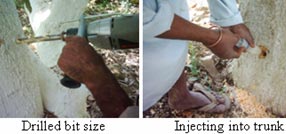
The same pesticides can also be applied by drilling followed by injecting in main trunk and its primary branches deep up to 6".Sorce: http://www.pakissan.com/english/advisory/aab.monitoringm.device.shtml
Mango Varieties
Chaunsa Mango:
Flesh firm, fibreless with pleasant flavour and sweet taste. Juice moderately adundant. Fruit quality good, keeping good quality. Ripening season in August.
Sindhri Mango:
Leading variety of Sind. Fruit shape ovalish long, size large, skin colour lemon yellow when ripe, pulp colour yellowish cadium, texture fine and firm fibreless, stone medium sized, flavour pleasantly aromatic and taste sweet.
Other Varieties of Mango
Langra:
It has originated as a superior chance seedling near Benares. Size medium to large, ovate, base round to slightly flatten, shoulders equal. Beak minute but distinct, sinus slight to absence, skin green and thin, flesh fibreless, yellowish brown in color, scented, highly melting, very sweet. Stone very small, flattened, oval. Weight of an average fruit is about ¼ kg. Fruit quality very good, bearing heavy. Season (Early to mid Season). 1st to 3rd week of July. Heavy yielder.
Amman Dusehri:
It derives its name form village between Lucknow and Malihabad where it was originated as a superior chance seedling. Size small to medium, oblong, ventral, shoulder higher than dorsal, beak and sinus absent, color yellow when ripe, skin thin, pulp fibreless, flesh firm, very sweet, flavor nice. Stone very small, oblong, variety good to very best, bearing heavy, mid season (July), keeping and peeling quality good.
Alphanso, Bombay:
This is a leading commercial variety of Bombay State and is one of the best in India. Because of its better adaptability to humid climate it has not been able to maintain its esteemed position in the dry districts of Pakistan. The Alphanso is successful in some districts of Sindh. Size medium, ovate, oblique, base obliquely flattened, Ventral structure boarder and much higher than dorsal, beak just a point, sinus not prominent, color of the ripe fruit yellow or brownish yellow, skin thin, pulp yellowish brown, flesh firm, taste very sweet, flavor excellent, almost fibreless. Fruit quality is good. Mid season variety harvested in July.
Sammar Bahisht:
It has originated as a superior chance seedling in Muzaffernager U.P. It got its name because of its pleasant flavor. Fruit medium, base slightly flattened, shoulders equal, sinus very light, beak point prominent, skin greenish yellow, thin, pulp yellow, very sweet, sparsely fibrous, flavor pleasant to delicious. Stone medium and oblong, oval. Quality of the fruit is very good, keeping and peeling qualities well. Ripening season July-August.
Fajrikalan:
It has originated as superior chance seedling in Bihar and gor its name after the name of lady Fajri who selected and brought up its trees. Size big, oblong, obliquely oval, base rounded, shoulder unequal, with ventral higher than the dorsal, beak distinct, sinus very shallow with rounded apex. Skin thin, pulp color pale, fibreless, taste sweet with pleasant flavor. Juice moderate to abundant. Stone large, oblong. Fruit quality good to very good bearing late season August, Keeping quality good.
Muhammadwala:
Size small to medium, skin thick, yellow brown, pulp sweet, juicy, stone medium sized, fiber very little. Very hard variety. Season early August.
Sammar Bahisht Chausa:
It is originated as choicest seedling in a village Chausa in Malihabad, Tehsil of Lucknow. It is also known as "Kajri" or "Khajri". There is resemblance between the foliage of Fajri and this variety but there are marked difference in fruit shape and quality. Fruit medium to large ovate to oval, base obliquely flattened, ventral shoulder raised than the dorsal, beak distinct, sinus shallow, apex round, skin medium in thickness, smooth, flesh firm, fibreless with pleasant flavor and sweet taste. Juice moderately abundant. Stone somewhat large oblong. Fruit quality good, bearing heavy, keeping quality medium to good. Ripening season in August (late).
Rataul (Anwar):
It has originated as a chance seedling in "Shohra-e-Afaq" Garden in Rataul. Now is has become popular in mango growing areas of Punjab because of its high flavor. Fruit medium, ovate, base flattened with equal shoulders, which are rounded, beak not prominent, absent in some cases, sinus absent, and apex round. Skin medium thick. Flesh firm, fibreless, flavor very pleasant, with very sweet taste. Juice moderately abundant. Some medium oval. Fruit quality very good. Ripening season in July (Mid-Season). Keeps well in storage.
Bangapali:
Another variety of Sindh. Fruit shape is obliquely oval, Size is big, length about 14 cm. Breadth 9.1 cm Thickness 8.2 cm. Weight 22.0 oz. Base obliquely flattened. Cavity not prominent. Stalk inserted obliquely. Shoulders ventral typically razed, broader and much more higher than dorsal. Back almost rounded. Skin color dark green and glazy when unripe. Yellowish light green with very light crimson patches when ripe. Surface smooth, shining. Dots small distinct. Glands small, crowded.
Neelam:
Quality variety of Sindh. Fruit shape ovate, size small, length 7.7cm breath 5.9cm thickness 5.6cm weight 5.0oz. The base is rounded. Stalk inserted squarely. Cavity slight to absent, Shoulders unequal. Ventral is higher than dorsal, back rounded. Sinus slight to shallow, Beak acute to obtuse. Apex rounded, Skin color sea green when unripe & yellow with reddish tinge when ripe. Surface smooth. Small dots with numerous small glands.
Mango Export 2000-2001
Th etotal production (estimated) is 988 thousand tonns. The total export during this is 183 thousand tonns with value of 3,453 million ruppees.
Source: Source: Ministry of Food, Agriculture and Ministry of Food, Agriculture and Livestock, Federal Bureau of Federal Bureau of Statistics
Flesh firm, fibreless with pleasant flavour and sweet taste. Juice moderately adundant. Fruit quality good, keeping good quality. Ripening season in August.
 |
| Season: July - September Origin: Rahim Yar Khan & Multan Color: Gold Flavor: Slight perfume Fiber: 17.2 - 27.3% Sugar Content: 18 - 22% Pulp Gravity: Heavy Moisture Content: 78% after ripening; 81% before ripening Weight: 1-2.3 Pounds Relative Humidity: 85% |
Sindhri Mango:
Leading variety of Sind. Fruit shape ovalish long, size large, skin colour lemon yellow when ripe, pulp colour yellowish cadium, texture fine and firm fibreless, stone medium sized, flavour pleasantly aromatic and taste sweet.
 |
| Season: Mid-May to mid-July Origin: Mir Pur Khas Color: Gold Flavor: Slight Perfume Pulp Gravity: Medium Fiber: 3 - 5% Moisture Content (average): 79% after ripening; 18% before ripening Weight: Average 1 - 3.5 pounds Relative Humidity: 85% |
Other Varieties of Mango
Langra:
It has originated as a superior chance seedling near Benares. Size medium to large, ovate, base round to slightly flatten, shoulders equal. Beak minute but distinct, sinus slight to absence, skin green and thin, flesh fibreless, yellowish brown in color, scented, highly melting, very sweet. Stone very small, flattened, oval. Weight of an average fruit is about ¼ kg. Fruit quality very good, bearing heavy. Season (Early to mid Season). 1st to 3rd week of July. Heavy yielder.
Amman Dusehri:
It derives its name form village between Lucknow and Malihabad where it was originated as a superior chance seedling. Size small to medium, oblong, ventral, shoulder higher than dorsal, beak and sinus absent, color yellow when ripe, skin thin, pulp fibreless, flesh firm, very sweet, flavor nice. Stone very small, oblong, variety good to very best, bearing heavy, mid season (July), keeping and peeling quality good.
Alphanso, Bombay:
This is a leading commercial variety of Bombay State and is one of the best in India. Because of its better adaptability to humid climate it has not been able to maintain its esteemed position in the dry districts of Pakistan. The Alphanso is successful in some districts of Sindh. Size medium, ovate, oblique, base obliquely flattened, Ventral structure boarder and much higher than dorsal, beak just a point, sinus not prominent, color of the ripe fruit yellow or brownish yellow, skin thin, pulp yellowish brown, flesh firm, taste very sweet, flavor excellent, almost fibreless. Fruit quality is good. Mid season variety harvested in July.
Sammar Bahisht:
It has originated as a superior chance seedling in Muzaffernager U.P. It got its name because of its pleasant flavor. Fruit medium, base slightly flattened, shoulders equal, sinus very light, beak point prominent, skin greenish yellow, thin, pulp yellow, very sweet, sparsely fibrous, flavor pleasant to delicious. Stone medium and oblong, oval. Quality of the fruit is very good, keeping and peeling qualities well. Ripening season July-August.
Fajrikalan:
It has originated as superior chance seedling in Bihar and gor its name after the name of lady Fajri who selected and brought up its trees. Size big, oblong, obliquely oval, base rounded, shoulder unequal, with ventral higher than the dorsal, beak distinct, sinus very shallow with rounded apex. Skin thin, pulp color pale, fibreless, taste sweet with pleasant flavor. Juice moderate to abundant. Stone large, oblong. Fruit quality good to very good bearing late season August, Keeping quality good.
Muhammadwala:
Size small to medium, skin thick, yellow brown, pulp sweet, juicy, stone medium sized, fiber very little. Very hard variety. Season early August.
Sammar Bahisht Chausa:
It is originated as choicest seedling in a village Chausa in Malihabad, Tehsil of Lucknow. It is also known as "Kajri" or "Khajri". There is resemblance between the foliage of Fajri and this variety but there are marked difference in fruit shape and quality. Fruit medium to large ovate to oval, base obliquely flattened, ventral shoulder raised than the dorsal, beak distinct, sinus shallow, apex round, skin medium in thickness, smooth, flesh firm, fibreless with pleasant flavor and sweet taste. Juice moderately abundant. Stone somewhat large oblong. Fruit quality good, bearing heavy, keeping quality medium to good. Ripening season in August (late).
Rataul (Anwar):
It has originated as a chance seedling in "Shohra-e-Afaq" Garden in Rataul. Now is has become popular in mango growing areas of Punjab because of its high flavor. Fruit medium, ovate, base flattened with equal shoulders, which are rounded, beak not prominent, absent in some cases, sinus absent, and apex round. Skin medium thick. Flesh firm, fibreless, flavor very pleasant, with very sweet taste. Juice moderately abundant. Some medium oval. Fruit quality very good. Ripening season in July (Mid-Season). Keeps well in storage.
Bangapali:
Another variety of Sindh. Fruit shape is obliquely oval, Size is big, length about 14 cm. Breadth 9.1 cm Thickness 8.2 cm. Weight 22.0 oz. Base obliquely flattened. Cavity not prominent. Stalk inserted obliquely. Shoulders ventral typically razed, broader and much more higher than dorsal. Back almost rounded. Skin color dark green and glazy when unripe. Yellowish light green with very light crimson patches when ripe. Surface smooth, shining. Dots small distinct. Glands small, crowded.
Neelam:
Quality variety of Sindh. Fruit shape ovate, size small, length 7.7cm breath 5.9cm thickness 5.6cm weight 5.0oz. The base is rounded. Stalk inserted squarely. Cavity slight to absent, Shoulders unequal. Ventral is higher than dorsal, back rounded. Sinus slight to shallow, Beak acute to obtuse. Apex rounded, Skin color sea green when unripe & yellow with reddish tinge when ripe. Surface smooth. Small dots with numerous small glands.
Mango Export 2000-2001
Th etotal production (estimated) is 988 thousand tonns. The total export during this is 183 thousand tonns with value of 3,453 million ruppees.
Source: Source: Ministry of Food, Agriculture and Ministry of Food, Agriculture and Livestock, Federal Bureau of Federal Bureau of Statistics
Wheat: Planning for better yield (بہتر پیداوار کے لئے منصوبہ بندی: گندم)

The wheat is sown the world over on an area touching 220 million hectares producing 600 million tons with an average of 2700 kg. of grain per hectare.
The Main land China brings 30 million hectares the largest are in the world followed by Russian Federation, India, USA, Australia, Canada, Turkey and Pakistan.
As far as the highest yield is concerned, France produces 7200 kg per hectare. Who leads other countries because it has much longer growing season of winter wheat? It is rather more appropriate to compare our wheat grain yields with countries of similar climatic and eco-zones, like Mexico and Egypt. Their yields are much higher owing both genetic constitution of cultivars and environment provided to them to express their biological potential.
Since Mexico and Pakistan are located in analogous ecological zones therefore, introduction of Mexican varieties in the country in sixties verities in the country in sixties ushered an era of green revolution. But unfortunately the pace of development could not be maintained for long and we now lag much behind the Mexican yields, who have gone for ahead of us producing 3900 Kg. of wheat grain per hectare as compared to 2491 K. for us in the year 1999, the best season. According to FAO statistics for 1995, among spring wheat growing countries Egypt has fantastic yield by producing 5422 kg. of grain per hectare where as Indian Punjab producing 4090 kg. and even India leads us in average yield by producing 2559 kg. notwithstanding three times largest area as compared to ours.
In our country wheat is cultivated largely (80 per cent), in irrigated areas whereas, rest in rain-fed. The yield and production in latter part of the country is predominantly controlled by rains during growing season, which usually are erratic. Hence yields are much lower during season of low precipitation.
There are of course three kinds of wheat cultivars, the long duration, the medium and short duration varieties. The wheat yields usually start declining after 20th Nov sowing at the rate of 20 kg per day.
Hence efforts must be made to plant it at optimum time. In cotton areas the sticks are by and large used as fuel in domestic house hold. Big heaps of cotton sticks can be seen along the roadside and in villages.
There is a great need to educate growers as to how much yield is last due to burning of sticks. So as to restores the soil fertility at least 80 per cent sticks may be buried in soil. In order to enhance the decomposition half a bag of urea per acre may be incorporated in the soil after the stick burial.
In view of numerous benefits through the addition of organic matter from cotton sticks, may be made mandatory for each farmer. In case wheat sowing is delayed owing to late maturity of cotton, wheat may be sown in standing crop, if there is low or no incidence of weeds. However in rice tract wheat should be sown on proper time immediately after crop harvest. In rice zone a sizable area must be brought under this season legumes, the chickpeas and lentils. It is of course not so difficult to reap their yields up to 1000 kg per acre, which will bring more finances to the growers as compared to raising wheat.
Adequate quantity of nitrogen, phosphorus and potash may be applied to harvest maximum grain. If phosphorus is added adequately it will not only help to realize good harvest, the following crop of cotton shall utilize the remaining residual phosphorus, without adding more of this element to cotton.
In my opinion there are three main factors, which largely contribute towards low wheat yields, the optimum time of sowing, prevalence of high intensity of weeds, imbalance use of fertilizer. The low level of organic matter is also important for holding the yield. In irrigated areas the crop is generally sown either after the harvest of cotton or paddy.
In most of the cases it is customary that farmers neither add organic matter nor farmyard manure to maintain fertility, thus resulting in low yields. In order to sow wheat at optimum time the cotton breeders in collaboration with cotton agronomists must try to reduce the life span of cotton crop without hampering the yield and deteriorating the quality of lint. In this way not only have substantial saving on the management of cotton but also timely sowing of wheat to realize maximum yields. As far as weeds are concerned it is estimated that decline in wheat yield ranges from 15 to 40 per cent or even more in some cases, which is indeed a great loss towards food self-sufficiency.
As my experience goes tit is much worst in certain localities where it appears as if wheat is an unwarted and obnoxious plant. It is in fact a glaring negligence on the part of extension workers and the grower himself.
The extension workers with the help of farmers may try to delineate the areas of high infestation of "Dumbi Sitti" and wild oats.
The farmers in such areas may be advised to control them through agronomic practices or herbicide treatment or removing the weed plants just after earring because at that stage it is easy to differentiate between both the weed and wheat plants.
If these weeds are not controlled now they will spread like a wild fire in coming years in whole of wheat areas. Thee weeds have capability to produce large quantities of seed, which is always shed before wheat harvest. Henceforth infestation increases at an alarming pace. These two weeds along with "It Sit" can be used as biological warfare in agriculture. On the other hand in barani areas "Pohalli" is quite a common weed, which can be easily seen while travelling by air, road or rail after the harvest of wheat.
The abundance of this weed undoubtedly is a main factor for low yield in the area. The Pohalli remain green much after harvest of crop. At that time it is an appropriate time to launch a campaign to eradicate it by uprooting and burning. Two or three exercise will help to whip out the weed in barani areas. Henceforth this year may be declared a Pohalli eradication year. The road sides and sides of rail tracks may also be cleared of it.
The pace of yield increase per hectare during past twenty years has been awfully poor rather frustrating since 1980 to 01. The population growth however, over whelmed the increase in yield per unit area therefore; the enlarged demand of wheat consumption was met by bringing more area under crop.
Which certainly is not a good omen. But for how long increase in area under crop shall come to our rescue. This problem has to be tackled through serious and wise planning and execution.
First of all we shall have to get rid of non-technocrats from lowest level to highest in the ministry of food, agriculture and livestock and induct able selfless agricultural scientists but not the pseudo ones. More funds have to be infused for research and transfer of technology. At the same time we must motivate the general public to diversify the so-called dietary pattern, is greatly imbalanced, which required to be substituted by balanced through intake of nutritive food, so as to reduce unnecessary burden on wheat. Besides this we must substantially boost yield per unit area. Thus placing this area under oil seeds, vegetables, fruits, pulses, and flowers. Also considerable area may be brought under fodder to raise ore animals for milk and meat production. Last but not the least we ought to arrest population growth.
With the improvement in agronomic practices we must try to equate with Egyptian or across the Punjab wheat yields in less than three or at the most five years.
Storage facilities: There are many stored grain pests, which destroy a considerable quantity of produce while in store in villages. Efforts may be made to eliminate the losses. If these losses are controlled it is possible that we may not have to import food grains any longer.
Courtesy Daily Dawn, 10 December 2001
The Main land China brings 30 million hectares the largest are in the world followed by Russian Federation, India, USA, Australia, Canada, Turkey and Pakistan.
As far as the highest yield is concerned, France produces 7200 kg per hectare. Who leads other countries because it has much longer growing season of winter wheat? It is rather more appropriate to compare our wheat grain yields with countries of similar climatic and eco-zones, like Mexico and Egypt. Their yields are much higher owing both genetic constitution of cultivars and environment provided to them to express their biological potential.
Since Mexico and Pakistan are located in analogous ecological zones therefore, introduction of Mexican varieties in the country in sixties verities in the country in sixties ushered an era of green revolution. But unfortunately the pace of development could not be maintained for long and we now lag much behind the Mexican yields, who have gone for ahead of us producing 3900 Kg. of wheat grain per hectare as compared to 2491 K. for us in the year 1999, the best season. According to FAO statistics for 1995, among spring wheat growing countries Egypt has fantastic yield by producing 5422 kg. of grain per hectare where as Indian Punjab producing 4090 kg. and even India leads us in average yield by producing 2559 kg. notwithstanding three times largest area as compared to ours.
In our country wheat is cultivated largely (80 per cent), in irrigated areas whereas, rest in rain-fed. The yield and production in latter part of the country is predominantly controlled by rains during growing season, which usually are erratic. Hence yields are much lower during season of low precipitation.
There are of course three kinds of wheat cultivars, the long duration, the medium and short duration varieties. The wheat yields usually start declining after 20th Nov sowing at the rate of 20 kg per day.
Hence efforts must be made to plant it at optimum time. In cotton areas the sticks are by and large used as fuel in domestic house hold. Big heaps of cotton sticks can be seen along the roadside and in villages.
There is a great need to educate growers as to how much yield is last due to burning of sticks. So as to restores the soil fertility at least 80 per cent sticks may be buried in soil. In order to enhance the decomposition half a bag of urea per acre may be incorporated in the soil after the stick burial.
In view of numerous benefits through the addition of organic matter from cotton sticks, may be made mandatory for each farmer. In case wheat sowing is delayed owing to late maturity of cotton, wheat may be sown in standing crop, if there is low or no incidence of weeds. However in rice tract wheat should be sown on proper time immediately after crop harvest. In rice zone a sizable area must be brought under this season legumes, the chickpeas and lentils. It is of course not so difficult to reap their yields up to 1000 kg per acre, which will bring more finances to the growers as compared to raising wheat.
Adequate quantity of nitrogen, phosphorus and potash may be applied to harvest maximum grain. If phosphorus is added adequately it will not only help to realize good harvest, the following crop of cotton shall utilize the remaining residual phosphorus, without adding more of this element to cotton.
In my opinion there are three main factors, which largely contribute towards low wheat yields, the optimum time of sowing, prevalence of high intensity of weeds, imbalance use of fertilizer. The low level of organic matter is also important for holding the yield. In irrigated areas the crop is generally sown either after the harvest of cotton or paddy.
In most of the cases it is customary that farmers neither add organic matter nor farmyard manure to maintain fertility, thus resulting in low yields. In order to sow wheat at optimum time the cotton breeders in collaboration with cotton agronomists must try to reduce the life span of cotton crop without hampering the yield and deteriorating the quality of lint. In this way not only have substantial saving on the management of cotton but also timely sowing of wheat to realize maximum yields. As far as weeds are concerned it is estimated that decline in wheat yield ranges from 15 to 40 per cent or even more in some cases, which is indeed a great loss towards food self-sufficiency.
As my experience goes tit is much worst in certain localities where it appears as if wheat is an unwarted and obnoxious plant. It is in fact a glaring negligence on the part of extension workers and the grower himself.
The extension workers with the help of farmers may try to delineate the areas of high infestation of "Dumbi Sitti" and wild oats.
The farmers in such areas may be advised to control them through agronomic practices or herbicide treatment or removing the weed plants just after earring because at that stage it is easy to differentiate between both the weed and wheat plants.
If these weeds are not controlled now they will spread like a wild fire in coming years in whole of wheat areas. Thee weeds have capability to produce large quantities of seed, which is always shed before wheat harvest. Henceforth infestation increases at an alarming pace. These two weeds along with "It Sit" can be used as biological warfare in agriculture. On the other hand in barani areas "Pohalli" is quite a common weed, which can be easily seen while travelling by air, road or rail after the harvest of wheat.
The abundance of this weed undoubtedly is a main factor for low yield in the area. The Pohalli remain green much after harvest of crop. At that time it is an appropriate time to launch a campaign to eradicate it by uprooting and burning. Two or three exercise will help to whip out the weed in barani areas. Henceforth this year may be declared a Pohalli eradication year. The road sides and sides of rail tracks may also be cleared of it.
The pace of yield increase per hectare during past twenty years has been awfully poor rather frustrating since 1980 to 01. The population growth however, over whelmed the increase in yield per unit area therefore; the enlarged demand of wheat consumption was met by bringing more area under crop.
Which certainly is not a good omen. But for how long increase in area under crop shall come to our rescue. This problem has to be tackled through serious and wise planning and execution.
First of all we shall have to get rid of non-technocrats from lowest level to highest in the ministry of food, agriculture and livestock and induct able selfless agricultural scientists but not the pseudo ones. More funds have to be infused for research and transfer of technology. At the same time we must motivate the general public to diversify the so-called dietary pattern, is greatly imbalanced, which required to be substituted by balanced through intake of nutritive food, so as to reduce unnecessary burden on wheat. Besides this we must substantially boost yield per unit area. Thus placing this area under oil seeds, vegetables, fruits, pulses, and flowers. Also considerable area may be brought under fodder to raise ore animals for milk and meat production. Last but not the least we ought to arrest population growth.
With the improvement in agronomic practices we must try to equate with Egyptian or across the Punjab wheat yields in less than three or at the most five years.
Storage facilities: There are many stored grain pests, which destroy a considerable quantity of produce while in store in villages. Efforts may be made to eliminate the losses. If these losses are controlled it is possible that we may not have to import food grains any longer.
Courtesy Daily Dawn, 10 December 2001
Wheat
Wheat
 Wheat (Triticum spp.) is a worldwide cultivated grass from the Fertile Crescent region of the Near East. In 2007 world production of wheat was 607 million tons, making it the third most-produced cereal after maize (784 million tons) and rice (651 million tons). Wheat grain is a staple food used to make flour for leavened, flat and steamed breads, biscuits, cookies, cakes, breakfast cereal, pasta, noodles, or biofuel. Wheat is planted to a limited extent as a forage crop for livestock, and the straw can be used as fodder for livestock or as a construction material for roofing thatch. Wheat (Triticum spp.) is a worldwide cultivated grass from the Fertile Crescent region of the Near East. In 2007 world production of wheat was 607 million tons, making it the third most-produced cereal after maize (784 million tons) and rice (651 million tons). Wheat grain is a staple food used to make flour for leavened, flat and steamed breads, biscuits, cookies, cakes, breakfast cereal, pasta, noodles, or biofuel. Wheat is planted to a limited extent as a forage crop for livestock, and the straw can be used as fodder for livestock or as a construction material for roofing thatch. | ||||||||||||||||||||||||||||||||||||||||||||||
| ||||||||||||||||||||||||||||||||||||||||||||||
| ||||||||||||||||||||||||||||||||||||||||||||||
Inventory of the Plants of Pakistan

INTRODUCTION
The primary goal of this project is a comprehensive inventory of the plants of Pakistan. This will be accomplished by 1) completion of the remaining family treatments of the published Flora of Pakistan, and 2) development of a web-accessible searchable relational database of all plant species in Pakistan. Eventually, we hope to create a revised, synopical Checklist of the Plants of Pakistan in both electronic and published form. This project will result in a complete modern Flora of approximately 6,000 species from a large, relatively poorly known region of South Asia, and the first complete floristic database for the region.
The primary goal of this project is a comprehensive inventory of the plants of Pakistan. This will be accomplished by 1) completion of the remaining family treatments of the published Flora of Pakistan, and 2) development of a web-accessible searchable relational database of all plant species in Pakistan. Eventually, we hope to create a revised, synopical Checklist of the Plants of Pakistan in both electronic and published form. This project will result in a complete modern Flora of approximately 6,000 species from a large, relatively poorly known region of South Asia, and the first complete floristic database for the region.
---- Acknowledgements ----
Overall institutional support for this project comes from the University of Karachi, Pakistan, and the Missouri Botanical Garden, St. Louis. Support for the completion of the published Flora of Pakistan has been provided by the US National Science Foundation, Division of Environmental Biology, Biotic Surveys & Inventories Program, through two grants, most recently DEB-0316828. Support for development of the electronic database and website has been provided by a grant from the US Department of Agriculture, Foreign Agricultural Service, Research & Scientific Exchanges Division, Scientific Cooperation Research Program. Additional support for this project was provided by grants to the Missouri Botanical Garden from the Andrew W. Mellon Foundation and from the Taylor Family Fund. The project investigators gratefully acknowledge the generous support for the Pakistan project from these institutions. For more information about this project, please contact Peter Hoch (peter.hoch@mobot.org).
---- Pakistan ----
Although established as an independent country only in August 1947, Pakistan occupies a position of great geostrategic and biogeographical importance, bordered by Iran on the west, Afghanistan on the northwest, China on the northeast, India on the east, and the Arabian Sea on the south (Fig. 1). Lying between 23-37° N and 61°-81° E, Pakistan has a total land area of 804,152 square kilometers, about twice the size of California. The altitude ranges from sea level to 8,611 m (at K2, the second highest peak on Earth), and temperature varies from well below zero in the high, glacier-clad mountains to 52°C (125°F) at Sibi in the plains. Mean annual precipitation ranges from c. 50 mm at Nok Kundi in Baluchistan to 2032 mm in the monsoonal uplands of Kashmir (Ali 1978). This great variation in elevation, temperature, precipitation, and other physical parameters has resulted in a diversity of biotic communities, and a relatively rich flora of at least 5,700 species of flowering plants (Ali 1978).
---- Biotic Regions of Pakistan ----
Pakistan sits astride one of the major disjunctions in the biota of southern Asia, with the line of demarcation running along the western edge of the Indus Basin and the deep dry upper Indus valley of Kohistan (Frodin 1984). This biogeographic disjunction was the mutual boundary between Boissier's Flora Orientalis (1867-1888) and Hooker's Flora of British India (1872-1897), the two standard floras of the late nineteenth century for Southwest and South Asia, respectively. One of the modern floras of the region, the Flora Iranica, initiated in 1963 by K. H. Rechinger (Vienna), follows this eastern boundary of Boissier's classic work, and so includes Baluchistan and the N.W.F. Provinces of Pakistan. The Flora Iranica does not, however, treat plants of the rest of Pakistan, including the very rich northeastern areas.

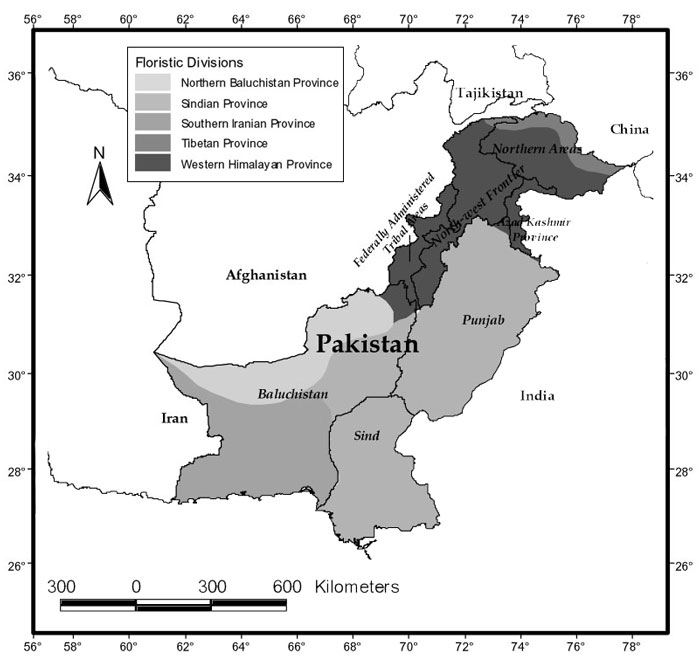
Figure 1. Map of Pakistan, showing boundaries of the four provinces (Baluchistan, Sind, Punjab, and North-West Frontier), one territory (Federally Administered Tribal Areas), and the Pakistani-administered portion of the disputed Jammu and Kashmir region (Azad Kashmir and Northern Areas). Shading indicates floristic provinces as delineated by Takhtajan (1986).
The underlying basis of this disjunction has been explored by numerous biogeographical analyses, such as those of Stewart (1972), Zohary (1973), Ali (1978), and Hedge & Wendelbo (1978). Takhtajan (1986), summarizing much of this literature, delineated five distinct floristic provinces that extend into the territory of Pakistan (Fig. 1). Two of these provinces, the Southern Iranian and Sindian Provinces, belong to the Sudano-Zambezian Region (African Subkingdom, Paleotropical Kingdom), which extends west along the southern Arabian Peninsula through the Horn of Africa to eastern tropical Africa and across to the Atlantic coast of Mauritania, Senegal, and Guinea. The other three floristic provinces in Pakistan belong to the Irano-Turanian Region (Tethyan Subkingdom, Holoarctic Kingdom): the Northern Baluchistan and Western Himalayan Provinces in the Western Asiatic Subregion, and the Tibetan Province to the Central Asiatic Subregion. Thus, the source and affinities of the plants of southern and southwestern Pakistan are with central and eastern Africa and the coastal regions along the Arabian Sea, whereas the source and affinities of the flora in northern Pakistan are with Central Asia, from Turkey in the west to the Gobi Desert in the east. In addition, eastern Pakistan has an admixture of elements from the Indomalesian Subkingdom (Paleotropical Kingdom), and in the monsoonal forests in Azad Kashmir, one finds elements of the Eastern Himalayan Province (Eastern Asiatic Region, Boreal Subkingdom, Holarctic Kingdom).
The flora of Pakistan includes no endemic families, and only three endemic genera (Douepia in Brassicaceae, Stewartiella in Apiaceae, and Decalepidanthus in Boraginaceae). In all, there are some 203 endemic species, or about 4% of the flora (Ali 1978). Many of these endemic species are found in the montane regions of northern Pakistan, particularly in the Chitral and Kashmir districts, and in northern Baluchistan. Notwithstanding, these regions are considered to be relatively poorly known and likely to be sources of new species (Chaudhri 1977, Frodin 1984).
Pakistan has a human population of some 141,500,000 (July 2000 est.), according to The World Factbook 2000 (www.odci.gov/cia/publications/factbook/geos/pk.html). Because some areas of Pakistan, especially the arid southwest (Baluchistan) and the mountainous north, are inhospitable and sparsely populated, this large population is heavily concentrated in the Indus Valley. The environmental impacts of this huge human population and the very long history of human occupation of the Indus Valley (home to a highly developed urban civilization at least 5,000 years ago) present special challenges to the government. Many of the most pressing environmental issues in Pakistan involve water, i.e., water pollution from raw sewage, industrial wastes, and agricultural runoff, and shortages of potable water for a majority of the populace. The other major environmental problems – deforestation, soil erosion, and desertification – are also closely tied to water use and availability.
---- Conservation & Environmental Issues ----
Pakistan has a human population of some 141,500,000 (July 2000 est.), according to The World Factbook 2000 (www.odci.gov/cia/publications/factbook/geos/pk.html). Because some areas of Pakistan, especially the arid southwest (Baluchistan) and the mountainous north, are inhospitable and sparsely populated, this large population is heavily concentrated in the Indus Valley. The environmental impacts of this huge human population and the very long history of human occupation of the Indus Valley (home to a highly developed urban civilization at least 5,000 years ago) present special challenges to the government. Many of the most pressing environmental issues in Pakistan involve water, i.e., water pollution from raw sewage, industrial wastes, and agricultural runoff, and shortages of potable water for a majority of the populace. The other major environmental problems – deforestation, soil erosion, and desertification – are also closely tied to water use and availability.
In order to begin to address these problems, Pakistan needs good information about its natural resources. A Flora based on all available plant collections and on the most current taxonomy and phylogeny of those plants is an essential first step to understanding, managing, and preserving the biodiversity of any area. Because terrestrial communities are generally defined by their plants, a Flora forms the foundation to which inventories of animals, fungi, etc., can be added. Completion of the Flora of Pakistan will provide scientists and government officials with critical information for management of their resources. Because the database resulting from this project will be geographical in nature, it can be used with data on soil types, precipitation, and other parameters to address questions such as what intact habitats should have highest priority for conservation, and what types of plants should be used in restorations for erosion control, reforestation, and the like.
Nasir (1991) conservatively estimated that 580-650 plant species (c. 12% of the flora) are threatened or endangered, but suggested that this number would increase when work on the Flora is completed. He cited habitat destruction, over-exploitation of economic plants, introduction of alien species, and pollution as the major causes for this threat. Nasir (1991), Sulaiman et al. (1991), and others suggest that awareness of the problems is widespread, but that additional knowledge and information is critical if the problems are to be addressed and solutions found. ---- Botanical Collecting in Pakistan ----
Stewart (1972, 1982), Hedge (1991), and others have reviewed the history of botanical exploration in Pakistan fairly extensively. Starting in 1820 with an expedition to Kashmir by William Moorcroft, many European (mainly British) botanists visited Pakistan, eventually collecting plants from virtually all parts of the country. The coverage was modest in the mountainous areas in the north, inhabited by often-hostile tribes and naturally inhospitable as the nexus of the Hindu Kush, Karakoram, and Himalayan ranges. The results of these collecting activities contributed to the two great floras of the region, the Flora Orientalis (Boissier 1867-1888) and the Flora of British India (Hooker 1872-1897). Collecting continued in the early twentieth century, rendering much of those great 19th century floras out-of-date. One important aspect about the collections made in Pakistan prior to the country's establishment in 1947 is that virtually all of them were housed either in Europe (mainly BM, E, and K) or in India, at Calcutta or Dehra Dun, in both cases inaccessible to botanists in Pakistan (Stewart, 1972). The largest plant collection in Pakistan in 1947 was that developed by Ralph Stewart at Gordon College in Rawalpindi.A comprehensive and accessible flora of this region is essential to our understanding of the plants of south Asia generally, and will be particularly useful in relation to floristic projects such as the Flora of China, the Flora Malesiana, and ongoing work in India and in the central Asian region. Many local Floras exist for parts of Pakistan (Stewart 1982), but these have been superseded by the Flora of Pakistan. The Flora of Afghanistan (Kitamura 1960) is actually a synoptical checklist in format, covering the results of expeditions to the Karakoram and Hindu Kush by Japanese botanists in 1955. A later report from the same expedition (Kitamura 1964) enumerated plants from the part of the region in Pakistan. This region where the Western Himalayas meet the Karakorams and the Hindu Kush in northern Pakistan and the northern Baluchistan region are rich in endemic plants, and many genera of agricultural and horticultural importance occur in Pakistan, yet our knowledge of them and access to information about them is limited at the present time.
---- History of the Flora of Pakistan Project ----
As the new nation of Pakistan began to develop universities and a scientific infrastructure, it became obvious that a first priority in the area of botany would be production of a Flora for the country. In 1960, Stewart retired from active work at Gordon College, and turned over his herbarium, then numbering about 50,000 specimens, to his collaborator Prof. E. Nasir. The "Stewart Herbarium" was later presented as a gift to the nation, and formed the nucleus of the National Herbarium of Pakistan (Ali & Ghaffar 1991). This collection, and those established at other institutions, particularly at the University of Karachi by S.I. Ali, provided the necessary foundation for writing the Flora. During the 1960's, the U.S. Department of Agriculture developed a scheme to use PL480 funds, which had to be spent within the country, to collect plants in Pakistan. That program ultimately did not survive, but the funds were still available and a new proposal was developed. The Flora of Pakistan project was initiated in 1968, with Nasir and Ali appointed as Joint Editors. They set to work immediately, and in 1970, the first fascicle (Flacourtiaceae) of the Flora appeared. Another of the early publications of the project was the "Annotated Catalogue of Vascular Plants of West Pakistan and Kashmir" by Stewart (1972), intended as a preliminary checklist of the plants of the region and a guide to the developing Flora project. Stewart included 5,783 species in his catalogue, and Flora treatments published subsequently have not changed that overall estimate appreciably (Ali 1991), although new treatments for individual genera/ families differ, sometimes substantially, from those by Stewart.By 1995 the Flora project had produced 197 treatments (one per family), ranging in size from a few pages to nearly 500 pages (Poaceae). Nasir (replaced by M. Qaiser after his death) and Ali or their colleagues and students wrote many of these treatments, while others have been completed by specialists worldwide working with them. Even though the herbaria within Pakistan have developed accordingly, the authors have had to consult extensively with British and other foreign herbaria since they contain large historical collections and the type specimens of most species in Pakistan. The USDA funding supported the publication of most of these treatments, but the PL480 program ultimately came to an end, and work on the remaining volumes needed to complete the Flora since 1995 has been hampered by lack of funding. The total number of species included in the 202 published treatments (see List) is about 4,200, which leaves some 1,500 species in 11 families (c. 25% of the entire flora) still to be treated.
---- The Flora of Pakistan: Current Status ----
In 1999, at the XVI International Botanical Congress, S.I. Ali (University of Karachi and principal editor of the Flora of Pakistan) proposed a plan to Peter H. Raven (Missouri Botanical Garden) for completing the Flora in five years with the Missouri Botanical Garden as co-publisher. Following negotiations, in February 2000, the University of Karachi and the Missouri Botanical Garden signed an agreement to co-publish the remaining volumes of the Flora of Pakistan over a period of five years. This initiative has several strong positive features:
---- Checklist of the Plants of Pakistan ----
The third "product" intended to derive from this project is the Checklist of the Plants of Pakistan. Just as Stewart's (1972) "Catalogue" was intended to summarize existing data and stimulate new research, so too do we intend for the Checklist to be a stimulus for future work. The format of the Checklist will be similar to that of the recent Catalogue of the Vascular Plants of Ecuador (Jørgensen & León 1999) and will present a synopsis of the entire flora of Pakistan. For each accepted name, this format will include author and citation, synonyms, abbreviated distribution statement, one verified voucher (and/or the type specimen, if from Pakistan), and references to major literature on the taxon. Introductory chapters will briefly summarize information about Pakistan's geology, paleoclimate, geography, climate, vegetation, and history of exploration. It will be based on the Pakistan Database, and will be available both electronically and as a published volume. However, all treatments will be reviewed and compared with current taxonomy and nomenclature, especially by reference to treatments in Flora Iranica, Flora of China, and recent monographs. Whenever possible, the family treatments for the Checklist will be sent to specialists for review. This type of revision will be particularly important for fascicles published early in the Flora project, and for groups in which current research is particularly active.
---- Database Development ----
The database for the Flora of Pakistan project is being developed on the same model as that for the Flora of China project (http://flora.huh.harvard.edu/china). Ali and colleagues will provide the remaining treatments (starting with Iridaceae) as Word documents, which will be parsed (paragraph-delineated) and converted into an Excel database. All earlier treatments will be scanned using an optical character reader (OCR) and saved as Word documents, edited for accuracy against the original, parsed, and converted. Each element of the Flora treatments – family descriptions, notes, and keys; generic descriptions, synonymies, notes, distribution, and keys; and species names, place of publication, types, synonymies, notes, indigenous uses, distribution, phenology, cited specimens, and illustrations – will be included in this interactive database. Ultimately, users will be able to search the database using a variety of queries. More than half of all species in the Flora of Pakistan are illustrated, and these drawings and photographs will be scanned and made available electronically.The specimens cited in the Flora of Pakistan, which include full available label data, are arranged according to a grid system (see map in DATA, which is included at the front of each volume of the FOP) rather than by province or district. Each grid unit corresponds to a "square" measuring 2° on each side. As a result, every cited specimen can be mapped to within 1° accuracy by using the central point in each grid unit, even though very few include latitude/longitude readings. So a specimen listed as "D-5" (corresponding to 30°-32° N/68°-70°E) can be mapped to 31°N/69°E. Eventually we intend to have coordinates for all localities in Pakistan, but until that system is in place, we already have a geographical basis for the database. The main database will be housed at the Missouri Botanical Garden as it is being constructed, and the web site will reside on a Garden server, at least initially. As soon as the University of Karachi has the capability to host the site, a mirror site will be installed there, making the information much more readily available in Pakistan and the surrounding region.
Many results of the proposed project will have a direct and beneficial impact on conservation efforts in Pakistan. Knowing what species occur where, at what elevations, with what other species, and whether the species is rare, is the type of information that is critical for informing decisions about where to establish conservation areas, how big to make them, etc. The ability to combine data on known collections, soil types, elevations, associated plants, and other parameters will make it possible to identify areas of potential distribution of rare species, or to select appropriate plants to be used in ecological restorations. In a country with limited resources suffering serious problems of deforestation, soil erosion, and desertification (Nasir 1991), the ability to make rapid, fully informed decisions regarding restoration and other conservation projects is extremely important, and depends on sufficient background data.
Stewart (1972, 1982), Hedge (1991), and others have reviewed the history of botanical exploration in Pakistan fairly extensively. Starting in 1820 with an expedition to Kashmir by William Moorcroft, many European (mainly British) botanists visited Pakistan, eventually collecting plants from virtually all parts of the country. The coverage was modest in the mountainous areas in the north, inhabited by often-hostile tribes and naturally inhospitable as the nexus of the Hindu Kush, Karakoram, and Himalayan ranges. The results of these collecting activities contributed to the two great floras of the region, the Flora Orientalis (Boissier 1867-1888) and the Flora of British India (Hooker 1872-1897). Collecting continued in the early twentieth century, rendering much of those great 19th century floras out-of-date. One important aspect about the collections made in Pakistan prior to the country's establishment in 1947 is that virtually all of them were housed either in Europe (mainly BM, E, and K) or in India, at Calcutta or Dehra Dun, in both cases inaccessible to botanists in Pakistan (Stewart, 1972). The largest plant collection in Pakistan in 1947 was that developed by Ralph Stewart at Gordon College in Rawalpindi.
As the new nation of Pakistan began to develop universities and a scientific infrastructure, it became obvious that a first priority in the area of botany would be production of a Flora for the country. In 1960, Stewart retired from active work at Gordon College, and turned over his herbarium, then numbering about 50,000 specimens, to his collaborator Prof. E. Nasir. The "Stewart Herbarium" was later presented as a gift to the nation, and formed the nucleus of the National Herbarium of Pakistan (Ali & Ghaffar 1991). This collection, and those established at other institutions, particularly at the University of Karachi by S.I. Ali, provided the necessary foundation for writing the Flora. During the 1960's, the U.S. Department of Agriculture developed a scheme to use PL480 funds, which had to be spent within the country, to collect plants in Pakistan. That program ultimately did not survive, but the funds were still available and a new proposal was developed. The Flora of Pakistan project was initiated in 1968, with Nasir and Ali appointed as Joint Editors. They set to work immediately, and in 1970, the first fascicle (Flacourtiaceae) of the Flora appeared. Another of the early publications of the project was the "Annotated Catalogue of Vascular Plants of West Pakistan and Kashmir" by Stewart (1972), intended as a preliminary checklist of the plants of the region and a guide to the developing Flora project. Stewart included 5,783 species in his catalogue, and Flora treatments published subsequently have not changed that overall estimate appreciably (Ali 1991), although new treatments for individual genera/ families differ, sometimes substantially, from those by Stewart.
In 1999, at the XVI International Botanical Congress, S.I. Ali (University of Karachi and principal editor of the Flora of Pakistan) proposed a plan to Peter H. Raven (Missouri Botanical Garden) for completing the Flora in five years with the Missouri Botanical Garden as co-publisher. Following negotiations, in February 2000, the University of Karachi and the Missouri Botanical Garden signed an agreement to co-publish the remaining volumes of the Flora of Pakistan over a period of five years. This initiative has several strong positive features:
- It will complete a Flora of an important and insufficiently known region;
- It connects geographically and floristically with the Flora of China project headquartered at the Garden (many taxa in common, often requiring a coordinated approach);
- It provides the best opportunity to develop a database of plants for south Asia, which can connect with comparable databases for China and elsewhere and can serve Pakistan as an important biodiversity management tool; and
- It will provide a source of new collections from that region, which is poorly represented in American herbaria.
The third "product" intended to derive from this project is the Checklist of the Plants of Pakistan. Just as Stewart's (1972) "Catalogue" was intended to summarize existing data and stimulate new research, so too do we intend for the Checklist to be a stimulus for future work. The format of the Checklist will be similar to that of the recent Catalogue of the Vascular Plants of Ecuador (Jørgensen & León 1999) and will present a synopsis of the entire flora of Pakistan. For each accepted name, this format will include author and citation, synonyms, abbreviated distribution statement, one verified voucher (and/or the type specimen, if from Pakistan), and references to major literature on the taxon. Introductory chapters will briefly summarize information about Pakistan's geology, paleoclimate, geography, climate, vegetation, and history of exploration. It will be based on the Pakistan Database, and will be available both electronically and as a published volume. However, all treatments will be reviewed and compared with current taxonomy and nomenclature, especially by reference to treatments in Flora Iranica, Flora of China, and recent monographs. Whenever possible, the family treatments for the Checklist will be sent to specialists for review. This type of revision will be particularly important for fascicles published early in the Flora project, and for groups in which current research is particularly active.
The database for the Flora of Pakistan project is being developed on the same model as that for the Flora of China project (http://flora.huh.harvard.edu/china). Ali and colleagues will provide the remaining treatments (starting with Iridaceae) as Word documents, which will be parsed (paragraph-delineated) and converted into an Excel database. All earlier treatments will be scanned using an optical character reader (OCR) and saved as Word documents, edited for accuracy against the original, parsed, and converted. Each element of the Flora treatments – family descriptions, notes, and keys; generic descriptions, synonymies, notes, distribution, and keys; and species names, place of publication, types, synonymies, notes, indigenous uses, distribution, phenology, cited specimens, and illustrations – will be included in this interactive database. Ultimately, users will be able to search the database using a variety of queries. More than half of all species in the Flora of Pakistan are illustrated, and these drawings and photographs will be scanned and made available electronically.